Medical Disclaimer: This article is for informational purposes only and does not constitute medical advice. Zepbound is a prescription medication that should only be used under the supervision of a licensed healthcare provider. Always consult your doctor before starting or changing any medication.
Zepbound arrived in late 2023 and pretty quickly became one of the most talked-about weight loss drugs on the market. It’s tirzepatide, the same active ingredient as Mounjaro, but approved specifically for chronic weight management rather than type 2 diabetes. The distinction matters because it affects insurance coverage, prescribing patterns, and how doctors talk about it with patients.
So what does the data actually say about how well it works?
The SURMOUNT trials in plain English
The SURMOUNT clinical trial program tested tirzepatide specifically for weight loss in people without diabetes. Here are the headline results:
SURMOUNT-1 (72 weeks, 2,539 participants): People on the highest dose (15mg) lost an average of 20.9% of their body weight. The placebo group lost 3.1%. For context, that’s roughly 52 pounds (24 kg) for someone starting at 250 pounds PMID: 35658024.
SURMOUNT-3 added a twist: participants did 12 weeks of intensive lifestyle intervention first, losing about 6.9% of body weight, and then received tirzepatide or placebo. The tirzepatide group went on to lose an additional 18.4%, bringing total weight loss to about 26.6%. That’s a level previously only seen with bariatric surgery PMID: 37840095.
SURMOUNT-4 tested maintenance: after 36 weeks on tirzepatide, people were randomly assigned to continue or switch to placebo. Those who continued kept losing (total ~25.3%), while those who stopped regained about half the weight they’d lost within the next year PMID: 38078870.
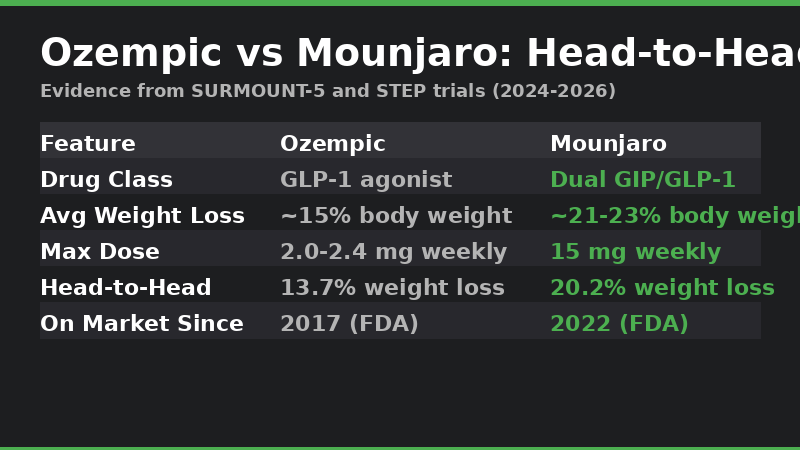
SURMOUNT-5 was the direct head-to-head: tirzepatide vs semaglutide (the active ingredient in Wegovy/Ozempic). Tirzepatide won, average weight loss of 20.2% vs 13.7% for semaglutide at 72 weeks PMID: 40353578.
Taken together, these trials tell a consistent story: tirzepatide produces more weight loss than semaglutide on average, but the gap narrows at lower doses and varies substantially between individuals.
How it’s different from Ozempic and Wegovy
Ozempic and Wegovy are GLP-1 receptor agonists, they target one receptor. Tirzepatide is a dual agonist: it hits both GLP-1 and GIP receptors. GIP is another incretin hormone that influences insulin secretion, fat metabolism, and possibly appetite regulation through different pathways than GLP-1.
A 2026 Lancet review on next-generation incretin therapies summarized the mechanism: GIP agonism appears to enhance the weight-loss effect of GLP-1 agonism beyond what either mechanism achieves alone, though the exact synergy isn’t fully understood PMID: 41547366.
A real-world study of prescribing patterns published in 2026 found that tirzepatide users lost about 3-5% more weight at 6 months compared to semaglutide users after adjusting for baseline differences, which roughly tracks with the clinical trial data PMID: 41968307.
Side effects: what to expect
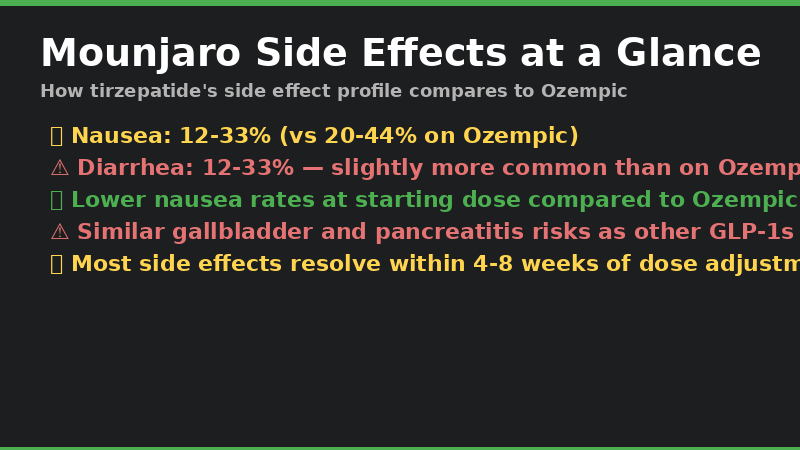
The side effect profile is familiar if you know GLP-1 medications: nausea, diarrhea, vomiting, constipation, all the GI stuff. A post-hoc analysis of SURMOUNT-5 found that GI side effects were actually slightly more common with tirzepatide than semaglutide, though most were mild to moderate and improved over time PMID: 41865857.
One thing to know: the dose escalation for Zepbound is more gradual than some people expect. You start at 2.5mg, then go to 5mg, 7.5mg, 10mg, 12.5mg, and finally 15mg, each step typically lasting at least 4 weeks. The slow ramp-up exists specifically to minimize GI side effects.
Real-world results vs clinical trials
Clinical trial results and real-world results often differ, trials have strict protocols, frequent check-ins, and highly motivated participants. Real-world data published in early 2026 from a digital weight management program integrating tirzepatide found that participants lost an average of 15-18% body weight at 6 months, which is a bit lower than trial numbers but still substantial PMID: 41788104.
A separate analysis looked at what happens when people discontinue tirzepatide. In a post-hoc analysis of SURMOUNT-4 data, people who stopped tirzepatide regained weight and saw their cardiometabolic markers (blood pressure, cholesterol, blood sugar) drift back toward baseline within a year PMID: 41284285. This reinforces what doctors have been saying: these are likely long-term medications, not short-term fixes.
Zepbound dosing: what the schedule actually looks like
The Zepbound titration schedule runs through six dose levels, and understanding why each step exists helps you stick with the process when side effects hit.
You start at 2.5 mg once weekly for at least 4 weeks. After that, you move to 5 mg, then 7.5 mg, 10 mg, 12.5 mg, and finally the 15 mg maintenance dose. Each step requires at minimum 4 weeks, so reaching 15 mg takes roughly 20 weeks from the first injection. This is the same escalation protocol used across the SURMOUNT trial program [PMID: 35658024].
The slow ramp exists because your gastrointestinal system needs time to adapt. Tirzepatide slows gastric emptying, and jumping to a higher dose too fast overwhelms the gut’s ability to compensate. The result is the nausea and vomiting everyone worries about, but dialed up to a level nobody wants. A post-hoc analysis of SURMOUNT-5 found that GI side effects cluster most intensely in the first 2-3 weeks after each dose increase and then gradually fade [PMID: 41865857].
Not everyone needs to reach 15 mg. Plenty of people get strong results at 7.5 mg or 10 mg and stay there indefinitely. The standard clinical approach is to find the lowest dose that produces steady weight loss, typically 1-2 pounds per week, and tolerable side effects. There’s no prize for reaching the maximum dose.
Missing doses happens. The official guidance: if you’re less than 4 days past your scheduled injection, take it as soon as you remember and resume your normal schedule. If more than 4 days have passed, skip the missed dose entirely and wait for the next scheduled one, then leave at least 3 days between that dose and the one after. Missing two or more consecutive doses is trickier. Most prescribers will drop you back down a dose level and re-escalate because restarting at a higher dose after a gap tends to bring side effects roaring back.
During the early weeks, many people notice appetite suppression within days but the real weight loss builds over months. Losing 3-5% of body weight in the first 8 weeks is common, with the pace often holding steady or accelerating as the dose rises and eating patterns shift.
How to get insurance to cover Zepbound
Getting insurance to pay for weight loss medication is often a process, but knowing how the system works puts you ahead of most people who give up after the first denial.
Prior authorization is where it starts. Almost every commercial insurer requires your doctor to submit a prior auth before covering Zepbound. The approval criteria are fairly standardized: you need a BMI of 30 or higher, or a BMI of 27 or higher with at least one weight-related comorbidity. Those comorbidities include hypertension, type 2 diabetes, high cholesterol, and obstructive sleep apnea. If your BMI is under 27, insurance almost certainly will not cover Zepbound for weight loss.
What your doctor puts in the prior auth submission matters a lot. A strong submission includes your starting BMI with date of measurement, a clear list of comorbidities (especially important if your BMI falls between 27 and 30), documentation that you’ve made genuine attempts at lifestyle modification, and a treatment plan that explicitly includes continued diet and exercise alongside the medication. Some insurers also want evidence that you’ve tried lower-cost alternatives first, like generic phentermine or Contrave, though this step-therapy requirement is applied inconsistently.
If the prior auth comes back denied, do not assume that’s the end of it. Insurers bank on people accepting the first no. Your doctor can file an appeal, and appeals succeed at a higher rate than most patients expect. The trick is addressing the specific reason for denial. If they claim medical necessity wasn’t established, the doctor needs to add more detail. If step therapy is required, ask exactly which medication they want you to try and whether there’s a clinical reason it’s inappropriate. A peer-to-peer review, where your prescribing doctor talks directly to the insurance company’s medical reviewer, can sometimes flip a denial that paperwork couldn’t budge.
On the money side, Zepbound’s list price runs about $1,060 per month without any coverage. If your commercial insurance covers it, copays typically range from $25 to $75, and Eli Lilly’s manufacturer savings card can push the copay down to as low as $25. For people with commercial insurance that explicitly excludes weight loss drugs, the savings card brings the monthly cost to roughly $550. If you’re paying entirely out of pocket with no insurance, the full list price applies, though some pharmacies offer discount programs that trim a bit off. The savings card cannot be used by people on Medicare, Medicaid, or other government insurance programs, and the terms change periodically, so check the manufacturer’s website for current details.
A few other things worth knowing: some larger employers have quietly added weight loss medication coverage as a standalone benefit outside their standard pharmacy formulary. It’s worth checking your benefits portal or asking HR directly. A handful of telehealth platforms now bundle Zepbound prescriptions with insurance navigation services that handle prior auths and appeals on your behalf. For people who’d rather not wrestle with paperwork, the membership fee can be worth it.
Who is a good candidate and who should be cautious
The FDA approved Zepbound for a specific population, and it’s narrower than “anyone who wants to lose weight.” Knowing where you fit, and where the caution flags are, helps you have a more productive conversation with your doctor.
The official indication covers adults with a BMI of 30 or higher, or a BMI of 27 or higher with at least one weight-related health condition like hypertension, type 2 diabetes, or high cholesterol. These match the enrollment criteria from the SURMOUNT trials, so the safety and efficacy data maps directly onto this group [PMID: 35658024].
There are two absolute contraindications where Zepbound should not be used, period. The first is a personal or family history of medullary thyroid carcinoma. Tirzepatide carries a boxed warning for this because rodent studies found thyroid C-cell tumors at clinically relevant exposures. We don’t know whether this finding translates to humans, but the risk isn’t one anyone should take. The second is Multiple Endocrine Neoplasia syndrome type 2, which is also an absolute contraindication. If anyone in your family has had either of these conditions, your prescribing doctor needs to know before writing the prescription.
A history of pancreatitis sits in a gray zone. GLP-1 receptor agonists have been associated with acute pancreatitis in post-marketing surveillance, though the absolute risk appears small. The label warns about it but doesn’t ban use outright. If you’ve had pancreatitis before, the decision to start Zepbound should involve a gastroenterologist and a careful weighing of the metabolic benefits against the potential for recurrence.
Gallbladder disease deserves attention too, though it’s not a contraindication. Rapid weight loss of any kind raises the risk of gallstone formation, and GLP-1 medications produce rapid weight loss by design. Someone with a history of gallstones or cholecystitis faces a compounded risk. Many prescribers will order a baseline gallbladder ultrasound if there’s a concerning history and monitor for symptoms during treatment.
A few other practical flags: Zepbound should be stopped at least two months before a planned pregnancy because the fetal effects are unknown and animal data raised concerns. People with significant gastroparesis or severe GI motility disorders may find the gastric-slowing effects make their condition worse. And if you have diabetic retinopathy, rapid improvements in blood sugar control have been associated with temporary retinopathy worsening in some patients, so current eye exams are important before starting.
The bottom line
Zepbound is currently the most effective FDA-approved medication for weight loss, based on the clinical trial data we have. It outperforms semaglutide on average, but individual responses vary a lot. Side effects are primarily gastrointestinal and usually manageable with gradual dose escalation. And like other GLP-1 medications, it appears to be a long-term treatment rather than a short course, stopping typically leads to weight regain.