Introduction
Medical Disclaimer: This article is for informational purposes only and does not constitute medical advice. Weight loss plateaus are complex. Consult your prescribing physician before making changes to your medication, diet, or exercise routine.
You started Ozempic and the pounds melted away. Week after week, the scale ticked downward, 5 pounds, then 15, then 25. You felt unstoppable. Then one morning you step on the scale and… nothing. The same number. Next week, same again. And the week after that.
You’re not alone. The Ozempic plateau is real, well-documented, and maddeningly common. It feels like the medication “stopped working”, but that’s almost never what’s happening under the hood.
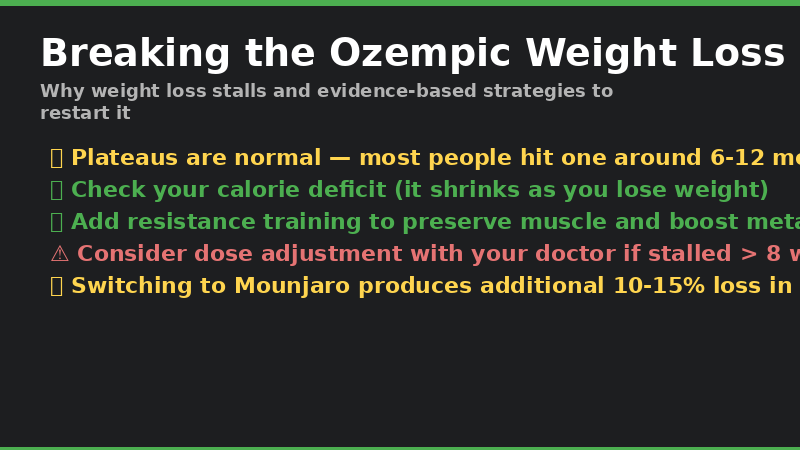
Here’s the uncomfortable truth most social media success stories don’t show: in the STEP 1 trial that got semaglutide approved for weight loss, participants lost an average of 14.9% of their body weight over 68 weeks [1]. But the weight loss curve wasn’t a straight line. It flattened. For nearly everyone, eventually.
This article explains why Ozempic plateaus happen, not with guesswork, but with actual physiology and clinical data. More importantly, it gives you an evidence-backed framework for breaking through.
What is a weight loss plateau on ozempic?
A plateau is four or more consecutive weeks with no meaningful change on the scale despite staying on your prescribed dose and maintaining your dietary and exercise habits.
It’s not the same as a bad week. Water retention from salt, hormonal fluctuations, constipation (common on semaglutide), or a weekend of heavier eating can all cause temporary stalls that resolve on their own. A true plateau persists.
When does it typically happen? Clinical data suggests two common windows:
- The 6-month mark. Many patients see rapid early loss that decelerates around months 4–6 as the body’s counter-regulatory systems push back.
- The 12-month mark. Even among participants who kept losing past month 6, the STEP trials showed loss rates tapering substantially by weeks 52–68 [1].
The average STEP 1 participant lost roughly two-thirds of their total weight in the first 36 weeks. The remaining third took another 32 weeks [1]. The slope flattens, and that flattening is not random.
Why plateaus happen (the real physiology)
If you’ve been told “just try harder” or “maybe you’re eating more than you think,” you’ve been given a behavioral explanation for a biological problem. The physiology runs deeper than willpower.
Metabolic Adaptation: Your Body’s Thermostat
When you lose weight, your body fights to get it back. This isn’t a character flaw, it’s evolution hard-wired into your hypothalamus. The phenomenon is called adaptive thermogenesis. In a classic 2008 study, Rosenbaum and colleagues demonstrated that people maintaining a 10% or greater weight reduction burned roughly 300–400 fewer calories per day than someone of the same size who had never lost weight [2].
Two people weighing 180 pounds, one who was always 180, one who dieted down from 220, do not have the same metabolism. The person who lost weight burns fewer calories at rest, during exercise, and even during sleep. Their body is actively trying to return to its previous weight.
Semaglutide suppresses appetite and slows gastric emptying, creating the calorie deficit that drives loss. But it doesn’t fully override the metabolic counter-response. At some point, typically after 5–15% body weight lost, your reduced energy expenditure catches up to your lower intake, and the deficit disappears.
Leptin Drops and Hunger Hormones Surge
As fat mass shrinks, so does leptin, the hormone that signals satiety. Meanwhile, ghrelin, the “hunger hormone,” can rebound. GLP-1 receptor agonism blunts much of this response (which is why the drug works), but it doesn’t eliminate it. A 2026 review in the British Journal of Pharmacology identified weight-loss plateaus as one of the “persistent challenges” of GLP-1 therapy, noting that counter-regulatory systems, including the endocannabinoid system, actively resist further loss [3].
Body Composition Shifts
As you lose weight, a portion of that loss is lean mass, muscle, bone density, organ tissue. Less lean mass means a lower basal metabolic rate. If you’ve lost 30 pounds and 20% was lean tissue, you’ve permanently lowered your calorie furnace. Your maintenance calories at the new weight are lower than someone who never carried extra weight.
Have you hit the maximum effective dose?
One of the most common, and most fixable, causes of a plateau is under-dosing.
The standard Ozempic titration moves through 0.25 mg, 0.5 mg, 1.0 mg, and eventually 2.0 mg (or 2.4 mg for Wegovy, the same drug branded for weight loss). But insurance hurdles, side effects, or prescriber caution mean many people stall at 0.5 mg or 1.0 mg.
Here’s the dose-response reality: in the STEP clinical program, the studied weight-loss dose was 2.4 mg weekly [1]. Lower doses produce lower average weight loss. If you’ve been at 0.5 mg for months with no movement, you may simply not have reached your effective dose.
That said, some people respond well to lower doses and reach goal weight without going to 2.0 mg. The question is: have you stopped losing at a weight still above a healthy range? If yes, dose escalation under medical supervision may be the simplest lever.
One important caveat: nausea and other GI side effects are dose-dependent. If you couldn’t tolerate 1.0 mg without misery, don’t white-knuckle your way to 2.0 mg. Other strategies (discussed below) don’t require maxing out the dose.
Is your calorie deficit actually working?
The mathematics of the calorie deficit shifts under your feet as you lose weight, and most people don’t recalculate.
A 220-pound person might burn 2,500 calories daily at maintenance. Eating 1,800 creates a 700-calorie deficit, roughly 1.4 pounds of fat loss per week. After losing 35 pounds and reaching 185, that same person now burns only 2,100 at maintenance. The 1,800-calorie intake that was producing 1.4 pounds per week now yields just 300 calories of daily deficit, less than 0.3 pounds per week. The deficit didn’t vanish, but it shrank by more than half.
Three practical steps:
- Recalculate your TDEE at your current weight using the Mifflin-St Jeor equation, not your starting weight.
- Track honestly for one week. Not forever, just seven days. Weigh and log everything. Studies consistently show people underestimate intake by 20–50%.
- Look for “calorie creep.” The tablespoon of olive oil that became two. The handful of nuts that became a bowl. These add up silently.
Slashing calories well below 1,200 per day almost always backfires. It accelerates muscle loss, spikes cortisol, and increases binge risk. Aim for precision, not punishment.
The role of exercise in breaking a plateau
If you’ve been relying on Ozempic to suppress appetite and haven’t added structured exercise, you’re missing the most potent plateau-busting tool.
Resistance Training (Non-Negotiable)
Remember the lean mass problem: some of every pound lost is muscle. Resistance training signals to your body: “keep this tissue, I’m using it.” Two to three sessions per week of progressive strength training preserve metabolic rate, improve insulin sensitivity, and improve body composition even if the scale moves more slowly.
A patient who loses 30 pounds and preserves muscle looks and feels different from one who loses 30 pounds and sheds significant lean mass. Same scale number, radically different outcome.
NEAT: The Hidden Lever
Non-Exercise Activity Thermogenesis, all the movement that isn’t formal exercise, can vary by up to 2,000 calories per day between individuals of the same size. Walking, fidgeting, standing, taking stairs. Semaglutide can reduce NEAT because fatigue is a known side effect. If your daily step count dropped from 8,000 to 4,000 after starting Ozempic, that alone could erase a 150–200 calorie daily deficit.
Track your steps. Get back to pre-medication levels, and then exceed them.
Cardio: Strategic, Not Excessive
Steady-state cardio burns calories and improves cardiovascular health, but doesn’t combat metabolic adaptation as effectively as resistance training. Use it as a supporting tool, 150 minutes per week minimum, but don’t make it the centerpiece.
When to talk to your doctor about switching medications
Not every plateau yields to better habits or a higher dose. For some people, semaglutide simply isn’t sufficient to reach a healthy weight.
Signs it may be time to discuss switching:
- You’ve been at the maximum tolerated dose for 12+ weeks with zero additional loss
- Your total loss is less than 5% of starting body weight (below the threshold for clinically meaningful loss)
- You still have significant weight to lose (BMI > 30, or > 27 with comorbidities)
- Side effects are manageable, suggesting you could tolerate an alternative
The most common switch: tirzepatide (Mounjaro/Zepbound), a dual GIP/GLP-1 receptor agonist that consistently produces greater weight loss than semaglutide. Other options include higher-dose semaglutide formulations or emerging multi-receptor agonists.
A 2026 modeling analysis in the Journal of the Academy of Nutrition and Dietetics found that plateaus are a major driver of treatment discontinuation and subsequent weight regain [4]. If you feel like giving up because the scale stopped, that conversation with your doctor is overdue.
Summary
The Ozempic plateau feels personal, like the medication let you down or your body is betraying you. The data says otherwise: plateaus are a predictable, near-universal feature of weight-loss pharmacology driven by metabolic adaptation, hormonal counter-regulation, and the simple physics of a shrinking calorie deficit.
Your action plan:
- Verify your dose. Are you at 2.0 mg (or 2.4 mg Wegovy)? If not, and you’re tolerating the medication, discuss titration with your prescriber.
- Recalculate your calorie needs at your current weight, not your starting weight.
- Audit your intake honestly for one week, the data often surprises people.
- Prioritize resistance training two to three times per week. Muscle preservation is metabolic preservation.
- Restore and increase NEAT. Track your steps. Target 8,000–10,000 daily.
- Re-evaluate in 8–12 weeks. If nothing has changed despite consistent execution, discuss alternative medications with your doctor.
A plateau is not a failure. It’s a signal, one that your approach needs recalibration, not abandonment. The biology may be stubborn, but it’s not invincible.
References
- Wilding JPH, Batterham RL, Calanna S, et al. “Once-Weekly Semaglutide in Adults with Overweight or Obesity.” New England Journal of Medicine. 2021;384(11):989-1002. PMID: 33567185
- Rosenbaum M, Hirsch J, Gallagher DA, Leibel RL. “Long-term persistence of adaptive thermogenesis in subjects who have maintained a reduced body weight.” The American Journal of Clinical Nutrition. 2008;88(4):906-912. PMID: 18842775
- Serra I, Bisconti E, Vergara D, et al. “Fatty acid amide hydrolase (FAAH) and the endocannabinoid system in obesity: Mechanistic insights and pharmacological opportunities beyond incretin-based therapies.” British Journal of Pharmacology. 2026. PMID: 42144898
- Hubert PA, Coleman C, Grosicki GJ, et al. “Mind the Plateau: A Mathematical Modeling Analysis of Long-Term GLP-1 Receptor Agonist Treatment.” Journal of the Academy of Nutrition and Dietetics. 2026;126(8):156366. PMID: 42055215
- Budini B, Luo S, Tam M, et al. “Trajectory of weight regain after cessation of GLP-1 receptor agonists: a systematic review and nonlinear meta-regression.” EClinicalMedicine. 2026;93:103796. PMID: 41938838
Last reviewed: June 15, 2026