Introduction
Important medical disclaimer: This article is for informational and educational purposes only. It does not constitute medical advice, diagnosis, or treatment. Pregnancy and medication decisions are uniquely personal and carry significant consequences for both mother and baby. You must speak with your prescribing physician and your obstetrician before making any decisions about continuing, stopping, or starting any medication during pregnancy or while trying to conceive. Never stop or change your medication without your doctor’s explicit guidance. If you are pregnant or suspect you may be pregnant while taking Ozempic, contact your healthcare provider immediately.
Ozempic (semaglutide) has transformed the treatment options for type 2 diabetes and chronic weight management. Millions of people now take this once-weekly GLP-1 receptor agonist. But for women of reproductive age, one question looms larger than any other: what happens if I get pregnant while taking Ozempic?
The concern is not theoretical. Ozempic is prescribed to women in their 20s, 30s, and 40s, precisely the age range when pregnancy is most common. Adding to the urgency, a growing body of evidence shows that GLP-1 medications may actually improve fertility in some women, creating a window of unexpected conception risk that catches many off guard.
This article walks through everything the current medical evidence tells us about semaglutide and pregnancy. We cover the biological reasons pregnancy and Ozempic do not mix, what the latest research reveals about real-world pregnancy outcomes after exposure, the fertility surprise that is generating headlines, practical steps to take if you conceive while on this medication, breastfeeding considerations, and safe alternatives for managing weight during pregnancy.
Why pregnancy and Ozempic don’t mix
The fundamental reason that semaglutide is not recommended during pregnancy comes down to what GLP-1 receptor agonists actually do inside the body. Understanding this mechanism makes the safety warning more than just a label, it becomes a clear biological rationale.
GLP-1 receptor agonists work by mimicking glucagon-like peptide-1, a natural hormone that your gut releases after eating. This hormone signals your pancreas to release insulin, slows stomach emptying, and acts on the brain to reduce appetite. In an adult trying to manage diabetes or lose weight, these effects are therapeutic. In a developing fetus, they raise serious concerns.
The placenta is not a perfect barrier. While some large-molecule drugs struggle to cross, semaglutide is a peptide with a molecular weight of approximately 4,113 daltons, small enough that placental transfer is plausible, especially given that the drug is bound to albumin in circulation, which itself crosses the placenta through receptor-mediated mechanisms. Animal reproductive studies submitted to the FDA showed that semaglutide does cross the placenta in rats, rabbits, and cynomolgus monkeys.
What happens on the other side matters. A developing fetus relies on a steady supply of glucose and nutrients delivered through the maternal bloodstream. GLP-1 receptor agonists reduce maternal food intake and slow gastric emptying, which could theoretically limit nutrient availability. More directly, GLP-1 receptors are expressed in fetal tissues, including the developing pancreas, heart, and central nervous system. Pharmacological activation of these receptors during critical developmental windows raises unanswered questions about long-term metabolic programming.
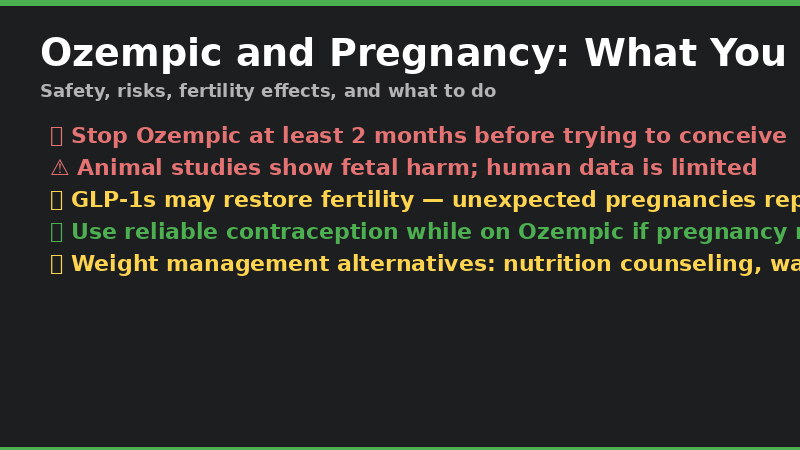
The FDA has assigned semaglutide to Pregnancy Category C under the old classification system, meaning animal studies have shown adverse effects and there are no adequate human studies. Under the newer Pregnancy and Lactation Labeling Rule (PLLR), the labeling states that semaglutide should be discontinued at least two months before a planned pregnancy due to its long half-life. This is not a casual warning. It reflects genuine uncertainty about fetal safety and a precautionary principle grounded in the drug’s mechanism of action.
Animal data bolsters the concern. In rabbit studies, semaglutide exposure during organogenesis produced cardiovascular malformations and increased early pregnancy loss at clinically relevant doses. In rats, reduced fetal growth was observed. Monkeys showed increased rates of early pregnancy loss. These are not trivial findings, and while animal data does not always predict human outcomes, in the absence of human safety data, regulators and clinicians treat these signals seriously.
What the research says
Human pregnancy data on GLP-1 receptor agonists has been sparse for years, largely because the drugs are contraindicated in pregnancy and most clinical trials exclude pregnant participants. That picture has started to change in 2025 and 2026, with several important studies filling in the evidence gap.
In May 2026, a research team published one of the most significant papers on this topic to date in Obstetrics & Gynecology. The study examined gestational weight gain and pregnancy outcomes in a cohort of women who had been exposed to semaglutide during early pregnancy before discontinuation. The findings provided the most granular look yet at what actually happens in human pregnancies after inadvertent first-trimester exposure PMID: 42208070.
A landmark paper in Annals of Internal Medicine in June 2026 used a target trial emulation design with claims data to compare pregnancy outcomes between women who continued GLP-1 receptor agonists into the first trimester versus those who stopped before conception. The study leveraged real-world data across a large population, offering the strongest observational evidence to date on the safety implications of first-trimester exposure. The publication was notable enough that the journal issued a patient summary alongside it, underscoring how many women face this exact clinical scenario PMID: 42258827, PMID: 42258824.
A comprehensive narrative review published in the Journal of Clinical Medicine in April 2026 examined the converging evidence on GLP-1 receptor agonists, fertility restoration, and reproductive safety. The review synthesized data across multiple drug compounds and pregnancy registries, concluding that while human teratogenicity has not been definitively established, the weight of mechanistic, animal, and emerging observational data supports the current recommendation to discontinue these medications before pregnancy PMID: 42122936.
Additional real-world data came from a June 2026 review in Current Diabetes Reports that specifically addressed the dilemma facing clinicians who manage women with type 2 diabetes considering pregnancy. The authors argued that for women with poorly controlled diabetes, the calculus is more nuanced, uncontrolled hyperglycemia in early pregnancy carries its own well-established teratogenic risks, and the relative risk of continuing a GLP-1 receptor agonist versus switching to insulin must be weighed individually PMID: 42262435.
A separate review in Current Opinion in Obstetrics and Gynecology in May 2026 provided OB-GYNs with a practical primer on what they need to know about GLP-1 receptor agonists, including pregnancy counseling recommendations. The piece emphasized that preconception counseling for women on these medications is now an essential component of primary and specialty care PMID: 42108205.
The consistent message across all of these publications is the same: the precautionary principle applies. While teratogenicity has not been proven in humans, the biological plausibility of harm combined with animal data and the absence of human safety trials means that discontinuation before pregnancy remains the standard of care.
Fertility surprise: Ozempic and unexpected pregnancies
One of the most talked-about developments in the GLP-1 story is the surge in so-called “Ozempic babies.” Social media platforms and patient forums are filled with reports from women who conceived unexpectedly after starting semaglutide or similar medications, sometimes after years of infertility attributed to polycystic ovary syndrome (PCOS) or obesity-related anovulation.
The biological mechanism behind this phenomenon is well-grounded. Obesity itself is a state of relative insulin resistance and chronic low-grade inflammation that disrupts the hypothalamic-pituitary-ovarian axis. Excess adipose tissue produces estrogen and alters sex hormone-binding globulin (SHBG) levels, contributing to anovulatory cycles. When a woman loses even 5 to 10 percent of her body weight, ovulation can resume. Semaglutide produces weight loss in that range for many patients, often within the first few months of treatment.
But there is more to the story than weight loss alone. A scientific literature review published in the International Journal of Molecular Sciences in May 2026 examined the direct effects of incretin therapies on ovarian function. The review found evidence that GLP-1 receptor agonists may improve ovarian function through mechanisms beyond weight reduction, including direct effects on ovarian GLP-1 receptors, improvements in insulin sensitivity at the ovarian level, and reductions in inflammatory mediators that impair folliculogenesis PMID: 42278283.
This fertility-restoring effect creates a specific clinical risk: women who previously believed they could not conceive may be taking Ozempic without contraception, only to discover they are pregnant weeks or months into treatment. The pharmacokinetics of semaglutide compound the problem. With a half-life of approximately one week and complete washout taking five to seven weeks after the last dose, a woman who discovers pregnancy at six weeks gestation may have had continuous fetal exposure throughout the critical first-trimester period of organogenesis.
The Journal of Clinical Medicine narrative review from April 2026 specifically highlighted this emerging public health concern, recommending that all women of reproductive age prescribed GLP-1 receptor agonists receive explicit counseling about the potential for restored fertility and the importance of effective contraception during treatment unless pregnancy is actively desired and planned PMID: 42122936.
A single-centre retrospective study published in the International Journal of Obesity in May 2026 examined long-term weight and pregnancy-related outcomes in women of reproductive age who had been exposed to liraglutide, another GLP-1 receptor agonist. The study found that among women who became pregnant after liraglutide exposure, weight trajectories and pregnancy outcomes were generally reassuring when the drug was stopped before pregnancy or very early in the first trimester, though the sample size limited definitive conclusions PMID: 42174221.
Taken together, the evidence points to a dual message: GLP-1 medications can improve fertility for women with metabolic barriers to conception, which is a positive outcome for those actively planning pregnancy, but it also demands heightened awareness and contraceptive vigilance for everyone else.
What to do if you get pregnant on Ozempic
If you discover you are pregnant while taking Ozempic, do not panic. But do act. Here is a clear, step-by-step guide based on current clinical recommendations.
Step one: Stop the medication immediately. Do not take your next scheduled dose. Contact your prescribing physician and your obstetrician the same day or the next business day. Do not wait for your next appointment.
Step two: Do not blame yourself. First-trimester medication exposure before pregnancy recognition is an exceptionally common scenario. An estimated 50 percent of pregnancies in the United States are unplanned, and many women take medications during the earliest weeks without knowing they are pregnant. The fact that you took Ozempic during early pregnancy does not mean your baby will have problems. It means you need appropriate monitoring and counseling, which your doctors can provide.
Step three: Schedule an early ultrasound and prenatal care visit. Your obstetrician will want to establish dating and check for normal early development. Depending on the timing and duration of your exposure, they may recommend a detailed anatomy scan at 18 to 20 weeks and possibly a fetal echocardiogram given the cardiovascular malformations seen in animal studies.
Step four: Discuss glucose management. If you were taking Ozempic for type 2 diabetes, abrupt discontinuation can cause blood glucose to rise. Uncontrolled hyperglycemia in early pregnancy is itself a teratogen, associated with neural tube defects, cardiac malformations, and other congenital anomalies. Your doctor may transition you to insulin, which is the standard of care for glycemic control during pregnancy and has decades of safety data supporting its use.
Step five: Consider enrolling in a pregnancy exposure registry. Novo Nordisk, the manufacturer of Ozempic, maintains a pregnancy exposure registry that collects data on outcomes after semaglutide exposure during pregnancy. Participation contributes to the body of knowledge that will help other women in your situation in the future. Your doctor can facilitate enrollment.
Step six: Address weight management expectations. Weight gain is a normal and necessary part of a healthy pregnancy. The Institute of Medicine publishes gestational weight gain guidelines based on pre-pregnancy BMI. Your doctor can help you understand what range is appropriate for you and how to achieve it through nutrition rather than medication.
The most important thing to remember is that the vast majority of pregnancies with inadvertent early medication exposure result in healthy outcomes. Work with your medical team, follow their monitoring plan, and focus on the factors within your control: nutrition, prenatal care, and stress management.
Breastfeeding considerations
Whether semaglutide passes into human breast milk is not well established. The drug’s molecular weight and protein-binding characteristics make transfer plausible, but the concentration that would reach a nursing infant and the clinical significance of that exposure remain unknown. The manufacturer’s labeling states that there are no data on the presence of semaglutide in human milk, the effects on the breastfed infant, or the effects on milk production. The recommendation is that breastfeeding women should not use Ozempic.
This creates a difficult situation for postpartum women who need glycemic control or weight management and are eager to restart a medication that worked well for them before pregnancy. The standard clinical approach is to continue insulin for diabetes management during breastfeeding if pharmacotherapy is needed. For weight management, the recommendation is to defer GLP-1 treatment until breastfeeding is complete.
The precautionary principle that governs pregnancy recommendations extends to lactation. A newborn’s metabolic and neurological systems are still developing. Exposing a nursing infant to a GLP-1 receptor agonist through breast milk, even if the theoretical risk is low, is difficult to justify when alternatives exist. Most clinicians advise patients to wait until they have fully weaned before resuming semaglutide.
That said, the field is evolving. As more women take these medications and more pregnancies occur, post-marketing surveillance and registry data will eventually provide answers about lactation safety. For now, the evidence gap means caution prevails.
Planning pregnancy: when to stop Ozempic
If you are actively trying to conceive or planning to try in the near future, the timeline for discontinuing semaglutide matters. The FDA label recommends stopping Ozempic at least two months before a planned pregnancy. This recommendation is driven by the drug’s pharmacokinetics: with a half-life of approximately one week, it takes roughly five to seven weeks to reach clinically insignificant plasma concentrations after the final dose.
Two months gives you a safety margin. It ensures that by the time conception occurs, the drug has essentially cleared your system. It also gives you time to work with your doctor on a transition plan, particularly if you rely on Ozempic for diabetes management.
For women with type 2 diabetes, the preconception period is critical. Blood glucose targets tighten during pregnancy. The American Diabetes Association recommends a hemoglobin A1c below 6.5 percent before conception if achievable without significant hypoglycemia. Achieving this on insulin rather than Ozempic takes time, education, and titration. Starting the transition two to three months before you begin trying to conceive is a reasonable timeline.
For women taking Ozempic for weight management alone, the picture is simpler pharmacologically but more complex behaviorally. The weight loss effects of semaglutide reverse after discontinuation, and regaining weight during the preconception period or early pregnancy can be emotionally difficult. Working with a registered dietitian who specializes in prenatal nutrition can help you develop a sustainable eating pattern that supports both your health and a future pregnancy without pharmacotherapy.
One practical point: because of the fertility effects discussed earlier, some clinicians recommend that women who stop Ozempic to try to conceive use ovulation predictor kits or fertility tracking from the very first cycle after discontinuation. The first ovulatory cycle after stopping may come sooner than expected.
Weight management alternatives during pregnancy
Pregnancy is not a time for weight loss. The goal shifts from calorie restriction and scale numbers to nutrient adequacy, appropriate gestational weight gain, and fetal growth. But for women who have been on a GLP-1 medication and are accustomed to pharmacologically supported appetite control, the transition to unmedicated eating during pregnancy can be jarring. Hunger signals return, food noise comes back, and the loss of a tool that was working can feel destabilizing.
Here is what current evidence supports for healthy weight management during pregnancy:
Medical nutrition therapy. A registered dietitian can help you build a meal plan that meets pregnancy nutrient requirements without excessive caloric surplus. Emphasis falls on protein adequacy, complex carbohydrates, healthy fats, and the micronutrients critical for fetal development: folate, iron, calcium, iodine, and choline.
Physical activity. The American College of Obstetricians and Gynecologists recommends at least 150 minutes of moderate-intensity aerobic activity per week during pregnancy for women without medical contraindications. Walking, swimming, stationary cycling, and prenatal yoga are all evidence-supported options. Exercise helps regulate gestational weight gain, reduces the risk of gestational diabetes, and improves mood.
Gestational diabetes management if needed. Women who were previously on Ozempic for type 2 diabetes or prediabetes are at elevated risk for gestational diabetes. Screening typically occurs at 24 to 28 weeks, but for higher-risk patients, early screening in the first trimester may be appropriate. If gestational diabetes develops, medical nutrition therapy and, if needed, insulin are the first-line treatments. Metformin is sometimes used off-label during pregnancy for gestational diabetes, though insulin remains the gold standard.
Behavioral support. Pregnancy is psychologically complex, especially for women with histories of weight struggle. The loss of a medication that quieted food noise can bring back disordered eating patterns. Cognitive behavioral therapy, mindful eating practices, and support groups can be valuable adjuncts during this period.
Medications that are compatible with pregnancy. Aside from insulin and, in some cases, metformin, few pharmacologic options for weight or glucose management are considered safe in pregnancy. The GLP-1 receptor agonists, as a class, are contraindicated. Bupropion and naltrexone, used in combination for weight loss as Contrave, are not recommended. Phentermine is contraindicated. Orlistat is not recommended. This leaves lifestyle modification as the cornerstone.
The good news is that pregnancy is time-limited. For most women, the postpartum period brings the option to resume GLP-1 therapy if desired, after breastfeeding considerations are addressed. Viewing the pregnancy period as a temporary phase with different rules and different goals can make the transition psychologically easier.
Summary
Ozempic and pregnancy should not coexist. The medication’s mechanism of action, animal reproductive toxicity data, absence of human safety trials, and pharmacokinetic profile all point toward the same recommendation: stop semaglutide before conception and do not use it during pregnancy or breastfeeding.
The evidence base has grown substantially in 2025 and 2026. We now have real-world pregnancy outcome data, target trial emulation studies, and comprehensive narrative reviews that reinforce the precautionary approach while also providing some reassurance that inadvertent first-trimester exposure does not guarantee adverse outcomes. The consistent finding across studies is that discontinuation as soon as pregnancy is recognized is appropriate, and most pregnancies with early exposure result in normal outcomes.
The fertility effects of GLP-1 medications are real and clinically significant. They demand explicit counseling and contraceptive planning for all women of reproductive age prescribed these drugs. The “Ozempic baby” phenomenon reflects the intersection of restored ovulation, weight loss, and insufficient awareness about the need for contraception during treatment.
If you become pregnant on Ozempic, act promptly but do not panic. Stop the medication, contact your doctors, and follow their monitoring plan. If you are planning pregnancy, work with your healthcare team to discontinue Ozempic at least two months in advance and develop a transition strategy for diabetes management or weight maintenance. And if you are breastfeeding, the current recommendation is to defer GLP-1 treatment until after weaning.
This is a rapidly evolving field. Pregnancy exposure registries are actively collecting data, and the coming years will almost certainly bring more definitive answers about the safety profile of these medications during the periconception and pregnancy periods. For now, the precautionary principle is the right one, and it is based on sound biological reasoning, not just regulatory caution.
References
Gestational Weight Gain and Pregnancy Outcomes After Semaglutide Exposure. Obstetrics & Gynecology. May 2026. PMID: 42208070
Continuing Glucagon-Like Peptide-1 Receptor Agonists Into the First Trimester of Pregnancy and Pregnancy Outcomes: A Target Trial Emulation Study. Annals of Internal Medicine. June 2026. PMID: 42258827
Summary for Patients: Continuing Use of GLP-1 Receptor Agonists Into the First Trimester of Pregnancy and Pregnancy Outcomes. Annals of Internal Medicine. June 2026. PMID: 42258824
GLP-1 Receptor Agonists, Fertility Restoration, and Reproductive Safety in Women of Reproductive Age: A Narrative Review. Journal of Clinical Medicine. April 2026. PMID: 42122936
Benefits of Incretin Therapy on Ovarian Function: A Scientific Literature Review. International Journal of Molecular Sciences. May 2026. PMID: 42278283
What OBGYNs Need to Know About GLP-1 Receptor Agonists. Current Opinion in Obstetrics and Gynecology. May 2026. PMID: 42108205
Use of Glucagon-Like Peptide-1 Receptor Agonists in Women with Type 2 Diabetes Before Pregnancy: Addressing the Dilemma in a Real-World Setting. Current Diabetes Reports. June 2026. PMID: 42262435
A Single Centre Retrospective Study of the Long-Term Weight and Pregnancy-Related Outcomes in Women of Reproductive Age Before and After Liraglutide Exposure. International Journal of Obesity. May 2026. PMID: 42174221