Introduction
One of the most overlooked side effects of rapid weight loss on GLP-1 medications is muscle loss. When the weight comes off fast — as it often does on Ozempic — not all of it is fat. Studies published in 2025-2026 indicate that a meaningful portion of the weight lost on GLP-1 agonists can come from lean body mass, not just fat.
This is a problem. Muscle isn’t just for looking toned — it’s your metabolic engine. Less muscle means a slower metabolism, which makes long-term weight maintenance harder. It also increases your risk of frailty, falls, and metabolic disease as you age.
The good news? Muscle loss on Ozempic is largely preventable. This guide covers the 2026 evidence on how to protect your muscle while losing fat.
Medical Disclaimer: This article is for informational purposes only. Consult your healthcare provider before starting any new exercise or supplementation regimen.
Why Ozempic Causes Muscle Loss
Muscle loss during weight loss isn’t unique to Ozempic — it happens during any calorie deficit. But Ozempic creates a perfect storm:
1. Rapid Weight Loss
When you’re losing more than 1-2 pounds per week, your body breaks down a proportionally larger amount of lean tissue. Ozempic users in the STEP 1 trial lost an average of 14.9% of body weight over 68 weeks — fast enough that muscle loss becomes a genuine concern. PMID: 33567185
2. Reduced Protein Intake
Ozempic suppresses appetite so effectively that many patients struggle to eat enough protein. This isn’t just anecdotal — weight loss trials consistently show reduced caloric intake across all macronutrients. When total intake drops, protein often drops with it unless you deliberately prioritize it.
3. Lower Activity Levels
Fatigue is a common Ozempic side effect, especially in the first few months, reducing spontaneous physical activity. Patients move less, which accelerates muscle loss through disuse.
4. Hormonal Changes
Rapid weight loss alters levels of growth hormone, testosterone, and cortisol — all of which influence muscle protein synthesis and breakdown.
How Much Muscle Are We Talking About?
Body composition analyses from the STEP trials and other GLP-1 studies show that a meaningful portion of the weight lost through these medications can be lean mass, not just fat. This is consistent with what happens during any significant calorie deficit: when energy intake drops sharply, the body breaks down both fat and muscle for fuel.
The exact proportion varies. Some substudies suggest lean mass accounts for 20-40% of total weight lost, depending on factors like diet quality, physical activity, and age. But the important point: this is largely preventable with adequate protein and resistance training. Data from patients who received nutrition and exercise counseling consistently shows better body composition outcomes than those who didn’t.
Strategy 1: Protein — The Non-Negotiable Foundation
How Much Protein Do You Need?
The standard RDA of 0.8g/kg/day is inadequate during active weight loss. Most sports nutrition and obesity medicine guidelines recommend more during calorie restriction:
| Weight Loss Phase | Protein Target | For a 200 lb (91 kg) Person |
|---|---|---|
| Active weight loss | 1.6-2.2 g/kg | 145-200 g/day |
| Weight maintenance | 1.2-1.6 g/kg | 109-145 g/day |
These targets are based on research showing that higher protein intake preserves lean body mass during energy restriction — a principle well-established in obesity and sports nutrition literature, not specific to any one medication.
Why So Much Protein?
During calorie restriction, your body defaults to breaking down muscle for amino acids. High protein intake:
- Stimulates muscle protein synthesis — counteracts the catabolic signals from calorie deficit
- Provides leucine — the key amino acid that triggers mTOR (the muscle-building pathway). You need 2.5-3g of leucine per meal.
- Increases satiety — protein is the most satiating macronutrient, complementing Ozempic’s appetite suppression
- Has a higher thermic effect — your body burns 20-30% of protein calories just digesting it
Practical Protein Strategies When You Have No Appetite
The biggest challenge on Ozempic: you’re not hungry. Here’s how to hit your protein targets anyway:
Prioritize protein at every meal. Eat your protein first, before vegetables or carbs. If you get full halfway through, at least you got the protein in.
Liquid protein is easier. When solid food feels impossible:
- Whey or plant protein shakes (25-30g per scoop)
- Fairlife Core Power Elite (42g protein, 230 calories)
- Collagen peptide bone broth (20g per cup)
- Greek yogurt smoothies (15-20g per cup)
Small, frequent protein doses. Instead of three large meals:
- 7am: Protein shake (30g)
- 10am: Greek yogurt (15g)
- 1pm: Chicken breast, half portion (35g)
- 4pm: Cottage cheese (15g)
- 7pm: Fish or lean meat, half portion (30g)
- Total: 125g (start with smaller portions)
Best protein sources ranked by efficiency (protein per 100 calories):
| Food | Protein (g) | Calories | Protein/100 Cal |
|---|---|---|---|
| Chicken breast | 31 | 165 | 18.8 |
| Whey isolate | 25 | 110 | 22.7 |
| Tuna (canned in water) | 22 | 100 | 22.0 |
| Egg whites | 11 | 52 | 21.2 |
| Nonfat Greek yogurt | 15 | 80 | 18.8 |
| 93/7 ground turkey | 23 | 170 | 13.5 |
| Cottage cheese (lowfat) | 13 | 82 | 15.9 |
| Salmon | 22 | 208 | 10.6 |
Strategy 2: Resistance Training
Diet alone will not preserve muscle. You need to tell your body that muscle is still needed.
Minimum Effective Dose
If you’re new to resistance training, here’s what works:
- Frequency: 2-3 sessions per week, non-consecutive days
- Exercises per session: 4-6 compound movements
- Sets per exercise: 2-3 working sets
- Reps: 8-12 per set (close to failure on the last 2 reps)
- Progression: Add weight or reps when you can complete all sets with good form
The 30-Minute Ozempic Workout
This minimal workout covers all major muscle groups:
| Exercise | Sets × Reps | Targets |
|---|---|---|
| Goblet squats | 3 × 10-12 | Quads, glutes |
| Dumbbell bench press | 3 × 10-12 | Chest, triceps |
| Dumbbell rows | 3 × 10-12 each | Back, biceps |
| Dumbbell overhead press | 2 × 10-12 | Shoulders |
| Romanian deadlifts | 3 × 10-12 | Hamstrings, glutes, lower back |
| Plank | 2 × 30-60 sec | Core |
Rest 60-90 seconds between sets. The whole session takes about 30 minutes.
Bodyweight Alternative
If you don’t have access to weights:
- Squats → bodyweight squats, progressing to Bulgarian split squats
- Bench press → push-ups, progressing to decline push-ups
- Rows → inverted rows under a table or bar
- Overhead press → pike push-ups
- Deadlifts → single-leg glute bridges
Strategy 3: Supplementation Worth Considering
Creatine Monohydrate
The most researched sports supplement available. 5g daily:
- Increases muscle strength and power output
- May help preserve muscle during calorie deficits
- Well-tolerated, inexpensive, no known long-term risks at standard doses
Vitamin D
Low vitamin D is associated with reduced muscle strength. If your levels are below 30 ng/mL, supplementation (2000-4000 IU/day) may help preserve muscle function during weight loss.
Omega-3 Fatty Acids
Some research suggests omega-3s (1-2g EPA/DHA daily) may reduce muscle protein breakdown during calorie restriction, though the effect is modest compared to protein and resistance training.
Signs You’re Losing Too Much Muscle
- Strength decreasing despite consistent training
- Excessive fatigue that doesn’t improve with rest
- Clothing fitting looser around shoulders, arms, and thighs — not just waist
- Weight loss exceeding 2% of body weight per week for multiple weeks
If you notice these signs, increase protein intake, reduce your calorie deficit, and talk to your doctor about possibly adjusting your Ozempic dose.
Summary
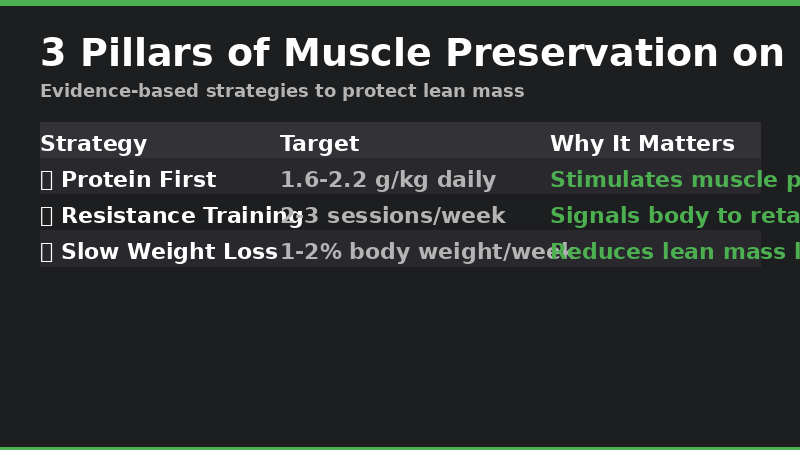
Muscle loss on Ozempic is real but preventable. The three pillars:
- Protein: 1.6-2.2 g/kg/day, prioritized at every meal
- Resistance training: 2-3 sessions per week, compound movements
- Pacing: Don’t lose more than 1-2% of body weight per week
The investment in muscle preservation pays off for decades — it’s your metabolic currency for maintaining weight loss and staying functional as you age. Don’t trade your muscle for a lower number on the scale.
References
- Wilding JPH, et al. “Once-Weekly Semaglutide in Adults with Overweight or Obesity.” New England Journal of Medicine. 2021. PMID: 33567185
- Prado CM, et al. “Strategies for minimizing muscle loss during use of incretin-mimetic drugs for treatment of obesity.” Obesity Reviews. 2025. PMID: 39295512
- Heymsfield SB, et al. “Voluntary weight loss: systematic review of early phase body composition changes.” Obesity Reviews. 2011. PMID: 20880128
Last reviewed: June 14, 2026


