Introduction
Losing significant weight on Ozempic is a major achievement. But for many people, the joy of reaching their goal weight is tempered by an unexpected challenge: loose, sagging skin.
When you lose 50, 80, or 100+ pounds — especially relatively quickly with GLP-1 medications — your skin doesn’t always snap back. It spent years stretching to accommodate the extra weight, and the elastin and collagen fibers that give it structure may be permanently damaged.
This guide covers what actually happens to your skin after Ozempic weight loss, what works for tightening in 2026 (and what doesn’t), and how to make informed decisions.
Medical Disclaimer: This article is for informational purposes only and does not constitute medical advice. Consult a board-certified dermatologist or plastic surgeon for personalized recommendations.
Why Ozempic Weight Loss Causes More Loose Skin
Loose skin isn’t unique to GLP-1 weight loss, but several factors make it more common:
1. Speed of Weight Loss
Ozempic and Mounjaro produce faster weight loss than lifestyle changes alone. When weight drops at 1.5-2.5 pounds per week (typical Ozempic pace), your skin has less time to adapt compared to slower, traditional weight loss (0.5-1 pound per week).
Skin remodeling — the process of breaking down old collagen and building new, tighter collagen — takes months. If weight loss outpaces this process, excess skin is left behind.
2. Total Amount Lost
The more weight you lose, the more your skin has been stretched and the less likely it can fully contract. The research suggests:
| Weight Lost | Likelihood of Noticeable Loose Skin |
|---|---|
| < 30 lbs | < 10% |
| 30-50 lbs | 25-40% |
| 50-80 lbs | 50-65% |
| 80-100+ lbs | 70-85% |
3. Age and Genetics
Skin elasticity declines with age. After roughly 35-40, collagen production decreases by about 1% per year. Genetics also play a major role — some people naturally have more elastic skin regardless of age.
4. Duration of Obesity
Skin stretched for 20 years has more structural damage than skin stretched for 5. Elastin fibers — which give skin its bounce — degrade over time under sustained tension.
Timeline: Will My Skin Tighten on Its Own?
Some natural skin retraction does happen after weight loss, but it takes time and varies dramatically between individuals. Age, genetics, total pounds lost, and how long you carried the weight matter more than any timeline you’ll find online. Give your body at least a year at a stable weight before assessing what’s permanent — what you see at 3 months may look very different at 12 months.
Strategies That Actually Help
Tier 1: Lifestyle (Foundation — Do These First)
Maintain a stable weight for 12+ months
Weight cycling — losing and regaining — further damages skin elasticity. The single best thing you can do for your skin is to keep the weight off. This gives your body the longest possible window for natural collagen remodeling.
Hydration
Dehydrated skin looks worse. Aim for 2-3 liters of water daily. Well-hydrated skin appears more plump and loose skin less pronounced.
Nutrition for Skin Health
| Nutrient | Role in Skin Health | Food Sources | Recommended Intake |
|---|---|---|---|
| Protein | Collagen building blocks | All protein sources | 1.2-1.6 g/kg/day |
| Vitamin C | Required for collagen synthesis | Bell peppers, citrus, kiwi | 75-90 mg/day |
| Zinc | Supports skin repair | Oysters, beef, pumpkin seeds | 8-11 mg/day |
| Omega-3 | Reduces inflammation | Salmon, sardines, walnuts | 1-2g EPA/DHA |
| Vitamin E | Skin antioxidant | Almonds, sunflower seeds, avocado | 15 mg/day |
Resistance Training to Fill Loose Skin
Building muscle in areas with loose skin can “fill out” some of the excess. While muscle doesn’t eliminate severely loose skin, it can improve appearance, especially in arms and thighs. Focus on:
- Arms: tricep extensions, bicep curls, overhead press
- Chest: bench press, push-ups
- Thighs: squats, lunges, leg press
- Glutes: hip thrusts, deadlifts
Tier 2: Non-Invasive Treatments (Moderate Results)
These treatments stimulate collagen production without surgery. Results are gradual and subtle.
| Treatment | How It Works | Sessions Needed | Cost Range (2026) | Expected Improvement |
|---|---|---|---|---|
| Microneedling + RF | Microneedles + radiofrequency heat stimulate collagen | 3-6 sessions | $500-1,200/session | 20-35% tightening |
| Ultrasound therapy | Focused ultrasound heats deep skin layers | 1-2 sessions | $2,500-5,000 | 20-30% tightening |
| Thermage | RF heats dermis, tightens existing collagen | 1 session | $2,000-4,000 | 15-25% tightening |
| CoolSculpting | Not for skin — targets remaining fat pockets. Can make loose skin look worse. | — | — | Avoid for loose skin |
Important: Non-invasive treatments work best for mild to moderate loose skin. For severe cases (large hanging skin folds), they won’t provide enough improvement — surgery is the only effective option.
Tier 3: Surgical Options (Significant Results)
For significant loose skin, surgery is the only approach that removes the excess tissue directly. Common procedures:
| Procedure | Areas Treated | Recovery Time | Cost Range (2026) |
|---|---|---|---|
| Abdominoplasty (tummy tuck) | Abdomen | 4-6 weeks | $8,000-15,000 |
| Brachioplasty (arm lift) | Upper arms | 2-4 weeks | $5,000-9,000 |
| Thigh lift | Inner/outer thighs | 4-6 weeks | $7,000-12,000 |
| Lower body lift | Abdomen, hips, thighs | 6-8 weeks | $15,000-30,000 |
| Breast lift | Breasts | 2-4 weeks | $6,000-12,000 |
When to consider surgery: After maintaining a stable weight for at least 12 months. Operating too soon increases the risk of needing revision surgery if weight changes.
Insurance coverage: Most insurers classify these as cosmetic procedures and do not cover them unless the excess skin causes documented medical problems such as recurrent rashes, infections, or functional impairment.
What Doesn’t Work (Save Your Money)
Despite what you’ll find online, several popular approaches lack evidence:
- Collagen supplements: While collagen peptides provide amino acids that support skin health, there’s limited evidence that oral collagen specifically tightens loose skin after major weight loss. They’re not harmful but unlikely to produce visible tightening on their own.
- Firming creams: Topical creams with retinol or peptides may slightly improve skin texture but cannot tighten significant loose skin. The active ingredients can’t reach deep enough.
- Dry brushing: Improves circulation and temporarily plumps skin but has no lasting effect on skin tightness.
- “Skin tightening” wraps and belts: Compression can temporarily smooth appearance but produces no lasting change to skin elasticity.
Non-Surgical Body Contouring: What to Expect
If you’re curious about non-surgical body contouring options after weight loss, it helps to understand what they can realistically do. Treatments like radiofrequency microneedling and focused ultrasound work by heating the dermis to trigger a wound-healing response, which stimulates new collagen production over 3-6 months. The collagen remodeling continues gradually, most people see the full result about 6 months after their last session.
One thing worth knowing: skin elasticity after semaglutide weight loss depends partly on how quickly you lost the weight. People who lost 50+ lbs over 6-8 months tend to see more laxity than those who took 10-12 months, because the skin’s structural proteins had less time to adapt. If you’re early in your journey and worried about loose skin, a slower titration schedule, staying at each dose level longer, is something to discuss with your prescriber.
For mild skin laxity, non-surgical options can produce meaningful improvement without the cost and recovery of surgery. For moderate to severe cases where skin hangs in visible folds, these treatments will tighten the skin to some degree but won’t eliminate the excess. That distinction matters when you’re deciding where to invest your money.
Collagen after weight loss: what the science says
Collagen supplements are everywhere in the weight loss space, but the evidence for oral collagen in tightening loose skin after significant weight loss is weak. Here’s what we actually know: collagen peptides are broken down into amino acids during digestion, just like protein from food. Your body then uses those amino acids wherever it needs them, it doesn’t preferentially send them to your skin.
A few small studies show modest improvements in skin hydration and elasticity with hydrolyzed collagen supplements, but these studies typically involve older adults with age-related skin thinning, not people recovering from 80+ lbs of weight loss. Eating adequate protein (1.2-1.6 g/kg/day) is far more important than supplementing with collagen specifically, because it provides all the amino acids your skin needs for repair.
Topical collagen is even less useful. Collagen molecules are too large to penetrate the skin barrier. Retinol and vitamin C serums have better evidence for stimulating collagen production at the surface level, but neither can fix the deeper structural laxity that comes with major weight loss.
Special Considerations for Ozempic Users
Plan Ahead
If you’re just starting Ozempic and anticipate losing 50+ pounds, the best time to think about loose skin is now. Strategies that help:
- Lose at a moderate pace (don’t rush to the maximum dose if you’re losing steadily at a lower one)
- Prioritize protein and resistance training from day one
- Stay hydrated throughout your weight loss journey
Stopping vs Continuing
Some patients consider pausing Ozempic or slowing their titration to give their skin more time to adapt. This is a reasonable discussion to have with your doctor — there’s no universal rule that you must always increase the dose on the standard schedule.
Summary
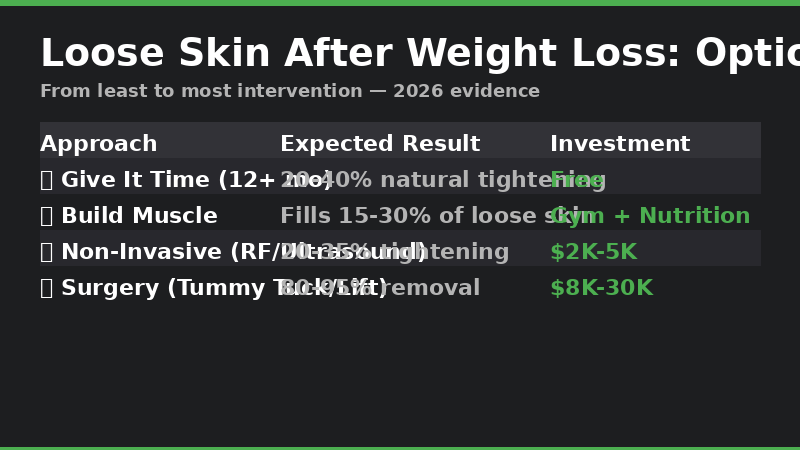
Loose skin after significant Ozempic weight loss is common but the severity varies widely. Your options, in order of increasing intervention:
- Give it time — natural remodeling continues for 12+ months at a stable weight
- Build muscle — fill some of the space with lean mass through resistance training
- Non-invasive treatments — microneedling, RF, and ultrasound for mild-to-moderate cases
- Surgery — body contouring procedures for significant excess skin that won’t resolve naturally
The right approach depends on how much weight you’ve lost, your age, genetics, and what you’re willing to invest. What matters most: don’t let loose skin diminish what you’ve accomplished. Losing the weight is the hard part — everything else is negotiable.
References
- Wilding JPH, et al. “Once-Weekly Semaglutide in Adults with Overweight or Obesity.” New England Journal of Medicine. 2021. PMID: 33567185
- American Society of Plastic Surgeons. “Body Contouring After Major Weight Loss.” 2025. plasticsurgery.org
Last reviewed: June 14, 2026