For years, doctors prescribed GLP-1 medications primarily for blood sugar control and, more recently, for weight loss. But something unexpected kept showing up in the data: people taking these drugs had fewer kidney problems. The FLOW trial, published in the New England Journal of Medicine in 2024, confirmed what many researchers suspected — semaglutide doesn’t just spare the kidneys, it actively protects them. This makes it one of the most promising diabetes kidney medications available today.
Medical disclaimer: This article is for informational purposes only and does not constitute medical advice. Always consult your healthcare provider before starting or changing any medication.
The kidney-GLP-1 connection
Your kidneys process about 150 liters of blood every day, filtering waste while retaining proteins and nutrients your body needs. Diabetes damages this filtration system over time , high blood sugar and high blood pressure slowly scar the delicate filtering units called glomeruli. This is why diabetes is the leading cause of kidney failure worldwide, responsible for roughly half of all cases requiring dialysis.
GLP-1 receptors exist in kidney tissue, and researchers have identified several ways these medications might help. Semaglutide reduces the high pressure inside kidney filtering units (intraglomerular pressure), decreases inflammation, and slows the scarring process known as fibrosis. A 2026 systematic review in Renal Failure examined the cardiorenal protective effects of GLP-1 receptor agonists in chronic kidney disease and found consistent evidence of benefit across multiple studies PMID: 41644273.
Unlike some diabetes medications that are restricted in advanced kidney disease, GLP-1 receptor agonists can be used across most stages of CKD , a major practical advantage.
The FLOW Trial: what it found and why it matters
The FLOW trial enrolled over 3,500 people with type 2 diabetes and chronic kidney disease. Participants received either semaglutide 1.0mg weekly or placebo, and researchers tracked a composite outcome: major kidney disease events including a sustained drop in kidney function, progression to kidney failure requiring dialysis or transplant, or death from kidney or cardiovascular causes.
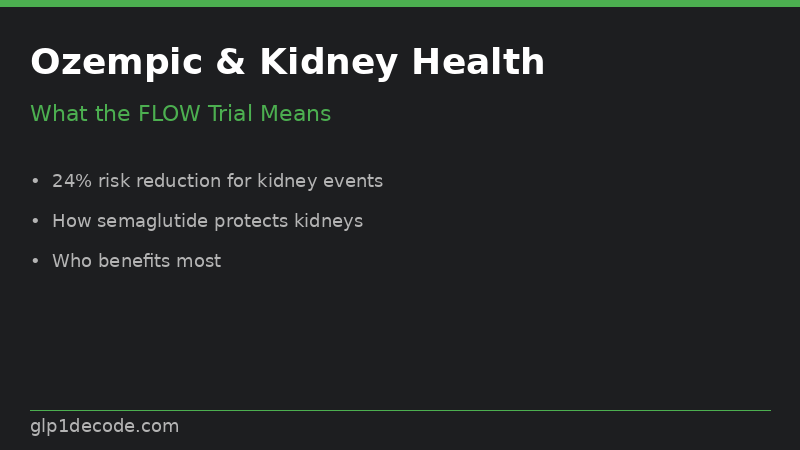
The results were striking. Semaglutide reduced the risk of major kidney events by 24% compared to placebo. The trial was stopped early because the benefit was so clear that continuing the placebo arm became ethically questionable PMID: 38785209.
This 24% risk reduction rivals or exceeds what we see with ACE inhibitors and ARBs , the standard-of-care blood pressure medications that have been the cornerstone of kidney protection for decades. Semaglutide achieved this on top of standard treatment, meaning patients were already taking these other protective medications.
How Ozempic protects kidneys (mechanism explained)
Semaglutide appears to work through several independent pathways. First, by lowering blood sugar and blood pressure, it reduces the baseline stress on kidney tissue. But the effect goes beyond these indirect benefits , the magnitude of kidney protection in the FLOW trial was larger than what blood sugar or blood pressure improvements alone could explain.
Researchers believe GLP-1 receptor activation directly reduces inflammation in kidney tissue, decreases oxidative stress, and slows the development of fibrosis , the scarring process that progressively destroys kidney function. A 2026 network meta-analysis in Frontiers in Endocrinology examined novel antidiabetic drugs in patients with CKD and found that GLP-1 receptor agonists showed consistent renal protective signals, ranking among the most effective options alongside SGLT2 inhibitors PMID: 41987895.
Who benefits Most: diabetes, ckd, or both?
The FLOW trial specifically studied people who had both type 2 diabetes and established chronic kidney disease , the highest-risk group. These participants had estimated GFR values between 25 and 75 mL/min/1.73m² and elevated urine albumin levels, meaning their kidneys were already showing significant damage.
The cardiovascular outcomes trials , SUSTAIN-6 and SELECT , also collected kidney data as secondary endpoints. SUSTAIN-6 found that semaglutide reduced new or worsening nephropathy by 36% in people with type 2 diabetes PMID: 27633186. SELECT showed that semaglutide 2.4mg preserved kidney function even in people without diabetes, though the baseline kidney risk in this population was lower PMID: 37952131.
A 2025 CVOT summit report examining cardiovascular, kidney, and metabolic outcomes trials noted that GLP-1 receptor agonists consistently demonstrate renal benefits across diverse patient populations, from those with preserved kidney function to those with advanced CKD PMID: 40316962.
The takeaway: if you have diabetes with any degree of kidney impairment, the renal protection data for semaglutide is strong. If you don’t have diabetes, the direct kidney benefit is less established but the cardiovascular and weight loss benefits still apply.
Ozempic and Creatinine: what your blood tests mean
When you start Ozempic, your doctor will monitor kidney function through blood tests , primarily creatinine and estimated GFR. One thing to know: significant weight loss can reduce serum creatinine simply because you have less muscle mass producing creatinine. This can make your eGFR number look artificially better. Your doctor will account for this when interpreting your labs.
More importantly, if you experience severe vomiting or diarrhea from Ozempic, dehydration can temporarily spike your creatinine. This is usually reversible with increased fluid intake, but it’s worth flagging to your doctor if you see a sudden change.
Safety: when to be cautious about kidneys on Ozempic
Semaglutide has a strong safety profile for kidneys, but there are a few situations that warrant extra attention. People with end-stage kidney disease on dialysis were excluded from the FLOW trial, so data in this population is limited. If you have severe CKD (eGFR below 25), discuss with your nephrologist whether the benefits outweigh the unknowns.
Acute kidney injury has been reported rarely with GLP-1 receptor agonists, typically linked to severe dehydration from gastrointestinal side effects. This isn’t a direct toxic effect of the drug , it’s a consequence of fluid loss. Staying hydrated, especially during the first few months of treatment, is your best protection.
The FLOW trial represents a genuine shift in how we think about Ozempic. It’s not just a diabetes drug or a weight loss drug , it’s a medication that protects vital organs. For people with diabetes and kidney concerns, this kidney data might be the most important reason to consider treatment.
References
- Perkovic V, et al. Effects of Semaglutide on Chronic Kidney Disease in Patients with Type 2 Diabetes. N Engl J Med. 2024. PMID: 38785209
- Cardiorenal protective effects of GLP-1 receptor agonists in CKD: a systematic review. Ren Fail. 2026. PMID: 41644273
- Efficacy and safety of novel antidiabetic drugs in CKD: a network meta-analysis. Front Endocrinol. 2026. PMID: 41987895
- Marso SP, et al. Semaglutide and Cardiovascular Outcomes in Patients with Type 2 Diabetes. N Engl J Med. 2016. PMID: 27633186
- Lincoff AM, et al. Semaglutide and Cardiovascular Outcomes in Obesity without Diabetes. N Engl J Med. 2023. PMID: 37952131
- CVOT summit report 2024: cardiovascular, kidney, and metabolic outcomes. Cardiovasc Diabetol. 2025. PMID: 40316962