Medical Disclaimer: This article is for informational purposes only and does not constitute medical advice. Gallbladder disease and pancreatitis are serious medical conditions. If you experience severe abdominal pain, especially with fever, nausea, or jaundice, seek emergency medical attention immediately.
There’s a tradeoff baked into every weight loss method that actually works: rapid weight loss increases your risk of gallstones. This was true long before Ozempic existed, it’s a known complication of very low-calorie diets, bariatric surgery, and any intervention that produces significant weight loss quickly.
The question with Ozempic and other GLP-1 medications isn’t whether there’s a gallbladder risk. There is. The question is how big that risk is, who faces it, and whether anything can be done about it.
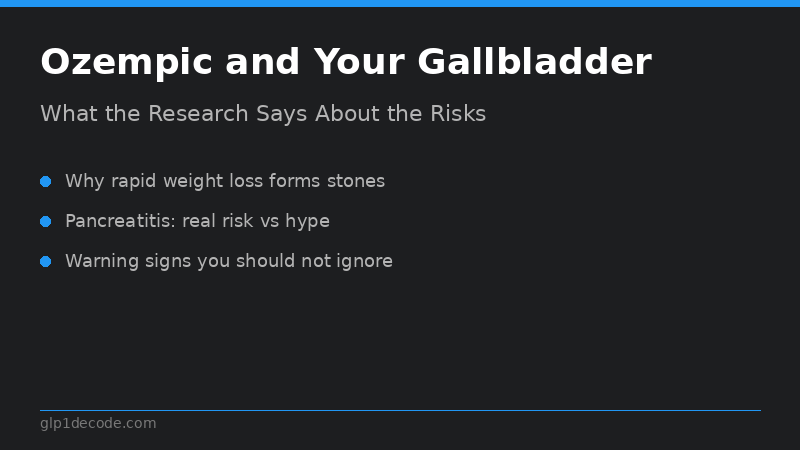
Why weight loss causes gallstones
Gallstones form when bile becomes supersaturated with cholesterol. During rapid weight loss, your liver secretes more cholesterol into bile while your gallbladder empties less frequently. The bile sits there, concentrates, and stone formation accelerates.
This isn’t unique to Ozempic or GLP-1 drugs. Any weight loss exceeding about 1.5 kg (3.3 lb) per week substantially increases gallstone risk. The mechanism is weight loss itself, not the specific method used to achieve it.
What the data shows for GLP-1 medications
A 2025 systematic review and meta-analysis published in Gastroenterology examined GI adverse events across GLP-1 receptor agonists and found that gallbladder and biliary events occurred more frequently in treated patients than controls, though the absolute risk increase was modest, roughly 3-5 additional events per 1,000 patient-years PMID: 40499738.
A 2026 cohort study specifically tracking gallstone and biliary complications in people with type 2 diabetes taking GLP-1 agonists found an increased risk of gallstone disease, especially during the first 6 months of treatment and in people losing weight rapidly (more than 1 kg per week) PMID: 42247589.
A 2025 study on incretin-based drugs and gallbladder risk across multiple cardiometabolic trials confirmed the signal but also found that the absolute risk was lower than the risk associated with severe obesity itself, meaning that some gallbladder events may reflect the underlying patient population more than the drug PMID: 40226782.
There’s an interesting twist in the data: some evidence suggests GLP-1/GIP dual agonists like tirzepatide may have a slightly lower gallbladder risk profile than pure GLP-1 agonists. A 2025 review proposed that GIP receptor activation might counterbalance some of the GLP-1-mediated effects on gallbladder motility, though this remains hypothetical PMID: 41459016.
What about pancreatitis?
Pancreatitis is a different beast, and more serious. The FDA added a warning about acute pancreatitis to all GLP-1 receptor agonists based on post-marketing reports, though the clinical trial data is less clear-cut.
The largest systematic review to date, from 2025, found no statistically significant increase in pancreatitis risk in randomized controlled trials of semaglutide, but noted that post-marketing surveillance data showed a signal that couldn’t be dismissed PMID: 40189856.
A perspective piece in Frontiers in Endocrinology summarized the evidence well: the pancreatitis risk from GLP-1 medications, if real, is very small, on the order of 1-2 additional cases per 1,000 patient-years, but the consequences of pancreatitis are serious enough that vigilance matters PMID: 34305810.
Who is at higher risk
Certain people should be more cautious about GLP-1 medications when gallbladder or pancreatic issues are a concern:
- History of gallstones or cholecystitis: prior gallbladder disease is the strongest predictor of recurrence during weight loss
- Rapid weight loss (more than 1.5 kg/week): this threshold consistently appears in the literature as a risk amplifier
- Very low-calorie intake: eating below 800 calories per day dramatically increases gallstone formation regardless of the cause
- Personal or family history of pancreatitis: GLP-1 medications are generally contraindicated in people with a history of pancreatitis
- High triglycerides: severe hypertriglyceridemia is an independent risk factor for pancreatitis
Warning signs to take seriously
Some discomfort is expected with these medications. But certain symptoms warrant immediate medical attention:
- Severe, persistent upper abdominal pain, especially if it radiates to your back (classic pancreatitis presentation)
- Right upper abdominal pain, especially after eating, and especially if it comes in waves (suggestive of gallstones)
- Jaundice, yellowing of the skin or eyes
- Fever with abdominal pain
- Dark urine or clay-colored stools
These aren’t things to “wait and see” about. If you have these symptoms, stop the medication and go to an emergency department.
Can you reduce the risk
Not entirely, some risk is inherent to rapid weight loss, but these strategies may help:
Don’t chase the fastest possible weight loss. The dose escalation schedule exists for a reason. Losing 0.5-1 kg per week rather than 1.5-2 kg dramatically reduces gallstone risk. If you’re losing faster than that, talk to your doctor about whether to slow down.
Eat enough fat to keep your gallbladder contracting. The gallbladder empties in response to dietary fat. A diet with zero fat means your gallbladder sits stagnant, which promotes stone formation. Including small amounts of healthy fat (olive oil, avocado, nuts) with meals helps keep things moving.
Stay at the lowest effective dose. Not everyone needs to reach the maximum dose. If you’re losing weight steadily at 1.0mg of Ozempic, there’s no medical reason to push to 2.0mg just because that’s the “full” dose.
Don’t ignore symptoms. Early gallbladder disease is much easier to manage than a gallstone lodged in a bile duct or a case of acute pancreatitis. If something feels wrong in your upper abdomen, get it checked.
Ursodeoxycholic acid and other preventive strategies
If your risk of gallstones during weight loss is high enough, your doctor may consider prescribing ursodeoxycholic acid, usually called UDCA or ursodiol. This is a naturally occurring bile acid that reduces the cholesterol saturation of bile, making stone formation less likely. It’s not a new drug; it’s been used for decades to dissolve existing cholesterol gallstones in people who can’t have surgery, and to prevent stone formation during rapid weight loss after bariatric surgery.
The bariatric surgery literature provides the strongest evidence for preventive UDCA. Multiple randomized trials in people undergoing gastric bypass or sleeve gastrectomy, procedures that produce very rapid weight loss, have shown that UDCA at 600mg per day reduces new gallstone formation by roughly 50 to 60 percent compared to placebo. A 2025 meta-analysis confirmed this protective effect and found it was most pronounced during the first 6 months after surgery, the period of fastest weight loss. The typical dosing is 300mg twice daily, and treatment usually covers the active weight loss phase, often 6 months.
Does this translate to GLP-1 weight loss? The mechanism is the same: rapid weight loss drives cholesterol supersaturation of bile, and UDCA counteracts that. No large randomized trial has specifically tested UDCA during GLP-1 treatment, so the evidence is extrapolated from bariatric surgery rather than direct. But the physiology is consistent, and some obesity medicine specialists already offer it to patients with prior gallbladder disease who are starting GLP-1 medications.
Who should consider it. Not everyone on Ozempic needs UDCA. The people who might benefit most are those with a history of gallstones or cholecystitis, people losing weight very quickly (more than 1.5 kg per week despite your best efforts to moderate), and those with known gallbladder sludge on a prior ultrasound. If you’ve already had your gallbladder removed, UDCA is irrelevant; the stones can’t form in an organ you don’t have. UDCA is generally well tolerated, though some people get mild diarrhea. It requires a prescription and should be discussed with your doctor, not self-started based on something you read online.
Other preventive medications have been studied less thoroughly. Some small studies looked at aspirin and NSAIDs for gallstone prevention with mixed results and no clear recommendation. Statins, which lower cholesterol systemically, have shown a modest protective association in observational studies, but this hasn’t been tested prospectively as a preventive strategy. For now, UDCA is the only evidence-based pharmacological option for gallstone prevention during weight loss.
Personal risk assessment: should you worry
The gallbladder conversation tends to produce two reactions: people who had no idea there was a risk and now feel blindsided, and people who have convinced themselves they’re definitely going to need emergency surgery. Neither position is well calibrated to the data. Let’s break down what your actual risk looks like.
If you have no history of gallbladder problems and are losing weight at a moderate pace, under 1 kg per week, your risk is very low. The absolute increase is roughly 3 to 5 additional gallbladder events per 1,000 patient-years, meaning that out of a thousand people like you taking the medication for a year, three to five will have a gallbladder issue that wouldn’t have happened otherwise. These odds are small enough that most people consider them acceptable, especially compared to the known risks of untreated obesity. You should still know the warning signs and not ignore upper abdominal pain, but you don’t need to lose sleep over this.
If you have a history of gallbladder disease, things shift. Prior gallstones or cholecystitis is the single strongest predictor of future episodes during weight loss. The gallbladder that formed stones once is primed to do it again when bile composition changes. The risk is higher but still manageable. People in this category should discuss UDCA prophylaxis with their doctor, aim for slower weight loss (half a kilo per week rather than a kilo), and be vigilant about symptoms. Having a prior gallbladder issue doesn’t mean you can’t take GLP-1 medications; it means you need a plan.
If you have a family history of gallbladder disease, especially in a first-degree relative who had stones at a young age, your baseline risk is elevated. Gallstone formation has a significant genetic component. You may want to be more conservative about your target rate of weight loss and discuss UDCA, but family history alone isn’t a reason to avoid treatment.
A quick self-assessment checklist. Ask yourself: have I ever had gallstones, sludge, or cholecystitis? Has anyone in my immediate family had gallbladder surgery before age 40? Am I losing more than 1.5 kg per week? Have I had right upper quadrant pain that I dismissed? Am I eating fewer than 10 grams of fat per day? If you answered yes to two or more of these, have a conversation with your doctor about gallbladder risk and prevention. If you answered no to all of them, your risk is low enough that you should know the symptoms but not dwell on the worry.
The bottom line on worry: for the average person without prior gallbladder issues losing weight at a moderate pace, GLP-1 medications don’t represent a meaningful gallbladder threat. For people with pre-existing risk factors, the risk is real but preventable in most cases. The worst outcome, a gallstone complication requiring emergency surgery, almost always comes with warning signs that were present for weeks or months beforehand. Paying attention is your best protection.
Diet modifications that protect your gallbladder
The food you eat directly affects gallbladder function, and a few simple adjustments can meaningfully reduce your stone risk without compromising your weight loss.
The most important dietary principle for gallbladder health on GLP-1 medications is to include some fat with your meals. It sounds counterintuitive when you’re trying to lose weight, but here’s why it matters. The gallbladder contracts and empties in response to dietary fat entering the small intestine. When you eat fat, your body releases cholecystokinin, which signals the gallbladder to squeeze. If your gallbladder never gets this signal, because your diet is extremely low in fat, bile sits stagnant and concentrates, the exact conditions that promote stone formation.
This doesn’t mean eating fried food or butter by the spoonful. Small amounts of healthy fat are enough: a drizzle of olive oil on vegetables, half an avocado, a handful of almonds or walnuts, a teaspoon of tahini. The goal is roughly 15 to 25 grams of fat spread across your day, not 0 grams. Very low fat diets, those with under 10 grams of fat per day, appear to be a particular problem because gallbladder emptying becomes essentially absent. If you’re on a GLP-1 medication with a suppressed appetite and find it hard to eat much of anything, make a point of including a small amount of fat in whatever you do eat.
Meal frequency also matters. Each time you eat a meal containing fat, your gallbladder empties. People who eat one large meal per day give their gallbladder one contraction event every 24 hours. People who eat three or four smaller meals get three or four contractions. More frequent gallbladder emptying means less time for bile to sit and concentrate, and lower stone risk. This is especially relevant on GLP-1 medications, where appetite suppression can make intermittent fasting or one-meal-a-day patterns appealing because you’re simply not hungry. From a gallbladder perspective, this is suboptimal. Two to three meals per day, each with a modest amount of fat, is the gallbladder-friendly pattern.
There’s also an interesting and well-replicated finding on coffee. Multiple large observational studies, including the UK Biobank and several Scandinavian cohorts, have found that coffee consumption is associated with a lower risk of gallstone disease and cholecystectomy. The effect appears dose-dependent: higher coffee intake is associated with greater protection, with some studies finding a 20 to 30 percent risk reduction in people who drink four or more cups daily. The mechanism isn’t fully established but likely involves caffeine stimulating cholecystokinin release and gallbladder contraction. Decaffeinated coffee doesn’t seem to have the same effect, suggesting it’s the caffeine rather than other coffee compounds. If you already drink coffee, this is a bonus. If you don’t, it’s probably not worth starting solely for gallbladder protection, but it’s a nice incidental benefit for coffee drinkers.
Other dietary factors have weaker evidence. Higher fiber intake has a modest protective association, possibly through effects on bile acid metabolism. Adequate hydration keeps bile less concentrated. Vitamin C intake shows a protective signal in some epidemiological studies, though the evidence isn’t strong enough for a specific recommendation. And contrary to popular belief, there’s no solid evidence that specific foods trigger gallstone attacks in people who already have stones, though very large fatty meals may trigger symptoms by causing a strong gallbladder contraction against an obstructed outlet.
The practical takeaway: eat two to three meals per day, include 5 to 10 grams of healthy fat with each one, and if you drink coffee, keep drinking it. These changes cost you nothing in terms of weight loss and meaningfully reduce your gallbladder risk.
The bottom line
GLP-1 medications do increase the risk of gallbladder problems, but the mechanism is primarily through rapid weight loss rather than a direct toxic effect of the drug. For most people, the absolute risk is small and manageable with sensible precautions. People with a history of gallbladder disease or pancreatitis should discuss these risks carefully with their doctor before starting treatment. And everyone on these medications should know the warning signs, because catching a problem early makes a big difference.