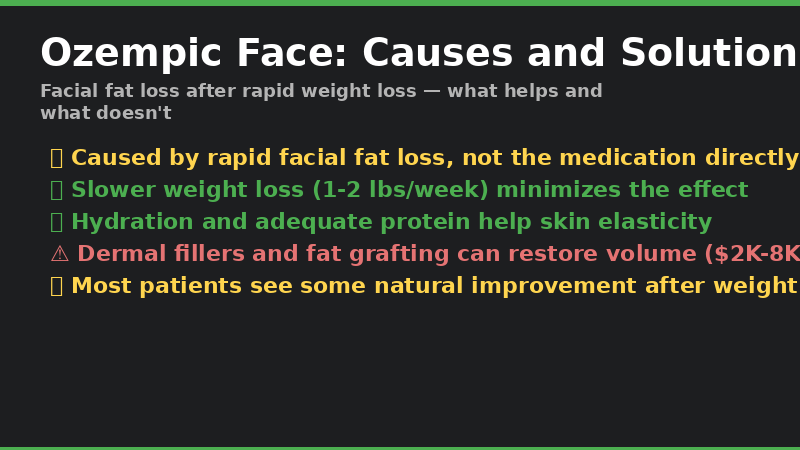
Ozempic Face: What It Is, Why It Happens, and How to Minimize It (2026)
Medical Disclaimer: This article is for informational purposes only and does not constitute medical advice. Consult a board-certified physician or dermatologist before beginning any treatment, discontinuing medication, or pursuing cosmetic procedures.
If you have been following GLP-1 receptor agonist news, you have almost certainly seen the phrase “Ozempic face” circulating in headlines and on social media. The term describes a constellation of facial changes, hollowed cheeks, pronounced nasolabial folds, loosened skin under the jawline, and an overall gaunt or prematurely aged appearance, that some people develop after losing substantial weight on semaglutide (Ozempic, Wegovy) or tirzepatide (Mounjaro, Zepbound).
While the popular name singles out one medication, the phenomenon is not unique to Ozempic. Any intervention that produces rapid, significant fat loss can alter facial volume. What makes GLP-1 receptor agonists noteworthy is the combination of speed, magnitude, and metabolic specificity with which they reduce adipose tissue, including the subcutaneous fat pads that give the face its youthful contour.
The encouraging news is that clinicians have studied this issue extensively since GLP-1 medications entered widespread use for weight management. A 2026 survey of 406 healthcare professionals who treat cosmetic concerns found a 137% mean increase in patients presenting with GLP-1 agonist-associated aesthetic issues [1]. The sheer volume of patients seeking solutions has driven a rapid expansion in the evidence base for both prevention and treatment. Below, we examine what the current literature tells us about the mechanisms, reversibility, and management of facial volume loss during pharmacologic weight loss.
What causes Ozempic face?
The pathophysiology involves three interconnected mechanisms, each supported by clinical and preclinical research.
Rapid Subcutaneous Fat Loss. Semaglutide 2.4 mg produced a mean weight reduction of 14.9% from baseline over 68 weeks in the STEP 1 trial, compared with 2.4% in the placebo group [2]. When total body weight declines at that pace, facial fat pads, collections of subcutaneous adipose tissue in the cheeks, temples, periorbital hollows, and pre-jawline area, shrink alongside visceral and peripheral fat stores. The face contains several anatomically discrete fat compartments, and volume loss in any of them alters surface contour. Cheek fat pad deflation deepens the nasolabial folds; temporal hollowing accentuates the bony orbital rim; submental and pre-jowl fat reduction can paradoxically create the appearance of laxity rather than a sharper jawline.
Adipose Stem Cell Alterations. One of the most striking recent discoveries comes from a 2026 controlled study that compared abdominal adipose tissue biopsies from patients receiving GLP-1 receptor agonists with those from untreated controls. Multiplex immunofluorescence analysis demonstrated a statistically significant reduction in adipose-derived stem cell (ADSC) markers, including FSP1, CD90, and CD105, in the GLP-1 group [3]. This finding raises the possibility that GLP-1 agonism does more than shrink mature adipocytes; it may deplete the progenitor cell population that underpins the body’s capacity to regenerate fat tissue. If corroborated in facial adipose depots, this mechanism could partly explain why some patients find facial volume recovery incomplete even after weight stabilizes.
Skin Quality Degradation. A comprehensive 2026 literature review on GLP-1 receptor agonists and skin quality documented dermal structure alterations alongside adipose compartment loss [4]. Collagen and elastin networks, which provide tensile strength and recoil to facial skin, do not remodel at the same tempo as fat volume declines. The resulting mismatch, deflated subcutaneous support beneath skin that has not yet contracted, produces the characteristic sagging and wrinkling associated with the “Ozempic face” phenotype.
It is worth noting that none of these processes are unique to GLP-1 medications. Bariatric surgery patients have long experienced similar facial changes; the same mechanism operates after any large-magnitude weight loss. What distinguishes the GLP-1 era is the number of patients affected and the velocity of tissue change, which can outpace the skin’s adaptive capacity.
Is it permanent?
The evidence supports a nuanced answer: partial recovery is common, but complete restoration to the pre-weight-loss facial architecture is not guaranteed.
Adipose tissue has some capacity for re-expansion once caloric balance stabilizes. Patients who maintain their reduced weight for 6–12 months frequently report modest improvement in facial fullness as the remaining adipocytes equilibrate and the dermis undergoes gradual remodeling. However, the stem cell depletion findings described above suggest a ceiling on endogenous recovery. If GLP-1 receptor agonists indeed reduce the adipose progenitor pool, the face’s regenerative reserve may be diminished.
Age at the time of weight loss is a major modifying factor. Dermal thickness and elasticity decline with chronological aging. A 45-year-old losing 20% of body weight over six months will generally exhibit more visible facial changes than a 25-year-old undergoing the same intervention, simply because the older patient’s skin has less intrinsic recoil capacity. Sun damage history, smoking status, and baseline facial fat distribution further modulate outcomes.
Importantly, the permanence question should not deter patients from pursuing medically indicated weight loss. The cardiovascular, metabolic, and mortality benefits of achieving a healthier body weight substantially outweigh the cosmetic considerations. The facial changes are addressable, and the strategies discussed below offer multiple avenues for mitigation.
How to minimize Ozempic face during weight loss
Prevention, or at least attenuation, is more effective than reversal. The clinical literature and expert consensus point to several actionable strategies that can be implemented while actively losing weight.
Gradual Titration and Moderate Caloric Deficit. The STEP 1 trial protocol used a 16-week dose-escalation schedule before reaching the maintenance dose of 2.4 mg weekly [2]. Adhering to a gradual titration schedule under physician supervision, rather than rushing to the maximum tolerated dose, gives facial tissues more time to adapt. Similarly, avoiding an excessively steep caloric deficit preserves a modest rate of loss. A deficit of 500–750 kcal/day below maintenance typically yields 0.5–1 kg of weekly loss, a pace at which skin and soft tissue remodeling can partly keep up.
Adequate Protein Intake. Protein provides the amino acid substrates for collagen synthesis. Current guidelines from the American Society for Metabolic and Bariatric Surgery recommend 1.0–1.5 g of protein per kilogram of ideal body weight daily during active weight loss. Meeting this target supports dermal integrity and may help preserve lean tissue, which indirectly cushions facial contour.
Hydration and Topical Skin Support. While no topical preparation can prevent subcutaneous fat loss, maintaining epidermal hydration with ceramide-containing moisturizers and daily broad-spectrum sunscreen (SPF 30+) protects the dermal matrix from photoaging. Cosmeceutical retinoids, applied at night, upregulate collagen gene expression in fibroblasts and may modestly improve skin thickness over months of consistent use.
Facial Exercise, Limited Evidence. Some practitioners recommend targeted facial muscle exercises to improve underlying muscular tone, which can provide subtle structural support beneath thinned fat pads. The evidence for this approach is anecdotal; no randomized trial has evaluated facial exercise during pharmacologic weight loss. If pursued, it should be viewed as a low-risk adjunct rather than a primary preventive strategy.
Micronutrient Optimization. Vitamin C serves as an essential cofactor for collagen hydroxylation. Zinc participates in fibroblast function and wound healing. Ensuring adequate intake of these and other micronutrients, either through diet or supplementation when laboratory values indicate deficiency, supports the skin’s structural maintenance during catabolic weight-loss phases.
Non-Surgical treatments that help
For patients who have already developed noticeable facial volume loss, a range of office-based interventions can restore contour without surgery. A 2026 survey of clinicians treating GLP-1-related aesthetic concerns documented the adoption patterns for non-surgical modalities [1].
Dermal Fillers. Hyaluronic acid (HA) fillers are the most frequently used intervention for Ozempic face. Injectable HA products can replace lost volume in the cheeks, temples, nasolabial folds, marionette lines, and pre-jowl sulcus. A typical correction for moderate GLP-1-related facial volume loss requires 2–4 syringes distributed across multiple facial zones, with effects lasting 9–18 months depending on the product cross-linking density and the patient’s metabolic rate. Calcium hydroxylapatite (Radiesse) and poly-L-lactic acid (Sculptra) offer alternative rheological properties; the latter functions as a biostimulatory agent that triggers de novo collagen production over a series of sessions rather than providing immediate volumetric fill.
Biostimulatory Injectables. Sculptra (poly-L-lactic acid) and hyperdilute Radiesse are increasingly used for pan-facial volumization in the GLP-1 population. These agents do not simply fill space, they stimulate fibroblast activity and collagen synthesis, gradually restoring dermal thickness over 3–6 months. This mechanism is particularly appealing given the collagen deficit that accompanies rapid weight loss. Treatment typically requires 2–3 sessions spaced 4–8 weeks apart, with results that can persist beyond 2 years.
Energy-Based Devices. Radiofrequency microneedling (e.g., Morpheus8, Secret RF) delivers thermal energy to the deep dermis and subcutaneous interface, triggering collagen contraction and neocollagenesis. Fractional radiofrequency and microfocused ultrasound (Ultherapy) tighten skin through similar mechanisms applied at different tissue depths. These modalities address laxity rather than volume loss per se, making them complementary to filler-based volumization.
Thread Lifts. Polydioxanone (PDO) and poly-L-lactic acid threads provide mechanical lifting and collagen-stimulating effects. While less durable than surgical facelift procedures, thread lifts offer a lower-cost, lower-downtime option for patients with mild-to-moderate jowling and midface descent following weight loss.
Surgical and injectable options
When non-surgical treatments provide insufficient correction, or when patients seek more permanent solutions, the following interventions enter the conversation.
Autologous Fat Transfer. Fat grafting, harvesting adipose tissue from the abdomen or thighs via liposuction and injecting it into facial compartments, has historically been the gold standard for facial volumization. However, a 2026 scoping review raised an important caution: GLP-1 receptor agonism may be fundamentally antagonistic to the mechanisms on which grafted fat survival depends [5]. The review synthesized preclinical evidence suggesting that semaglutide, liraglutide, and tirzepatide alter adipocyte biology in ways that could reduce graft take rates. Surgeons performing fat transfer on patients with recent or ongoing GLP-1 exposure should consider this risk and counsel patients accordingly. A washout period before surgery may improve outcomes, though no consensus protocol yet exists.
Facelift (Rhytidectomy). For patients with significant skin laxity after substantial weight loss (often those who have lost 30 kg or more), surgical facelift remains the most definitive intervention. A deep-plane or SMAS facelift repositions the underlying muscular-aponeurotic layer and redrapes the skin, addressing both laxity and contour. The procedure requires general anesthesia, carries the standard surgical risks (hematoma, nerve injury, scarring), and involves 2–4 weeks of initial recovery. Candidates should be at a stable weight for at least 3–6 months before undergoing surgery.
Neck Lift and Platysmaplasty. Submental fullness often coexists with facial volume loss during GLP-1 weight reduction. When the platysma muscle bands become visible and neck skin laxity is pronounced, a neck lift, with or without concurrent facelift, can restore cervicomental definition.
Blepharoplasty. Periorbital hollowing is one of the earliest and most aging-associated signs of facial fat loss. Upper and/or lower blepharoplasty removes excess eyelid skin and repositions or recontours orbital fat, addressing the tired, hollow-eyed appearance that frequently accompanies rapid weight reduction.
Ozempic face vs. normal aging
Clinicians who evaluate cosmetic patients find it important to distinguish pharmacologic facial volume loss from chronological aging, because the treatment algorithms differ.
Normal facial aging follows a predictable sequence: bone resorption in the orbital rim and maxilla, descent of the midface fat compartments (not just volume loss but inferior migration), thinning of the superficial musculoaponeurotic system (SMAS), and progressive dermal collagen loss. These changes unfold over decades.
GLP-1-related facial changes, by contrast, are driven primarily by acute adipose tissue reduction. The bony framework, SMAS position, and vascular supply remain largely unchanged, the deficit is volumetric rather than structural. This distinction has practical implications because pure volume replacement (fillers) often achieves more dramatic correction in the GLP-1 population than in age-matched controls, where multiple layers of tissue require intervention.
A patient who has lost 15 kg on semaglutide at age 40 may present with facial hollowing that mimics a decade of chronological aging. However, once volume is restored with fillers or biostimulatory agents, the underlying tissue quality is frequently better than that of a genuinely older patient, because cumulative photoaging and bone resorption have not had time to accrue. This is, in a sense, the silver lining: GLP-1 facial changes can look severe initially but often respond favorably to treatment.
Summary
“Ozempic face” is a real and increasingly common clinical phenomenon rooted in the rapid reduction of facial subcutaneous adipose tissue during GLP-1 receptor agonist therapy. Research published through mid-2026 has clarified three core mechanisms: volumetric fat pad deflation, depletion of adipose-derived stem cell populations, and a mismatch between the pace of fat loss and dermal remodeling capacity.
The condition is partially, but not always completely, reversible through endogenous tissue recovery. Practical preventive measures include gradual dose titration, adequate protein intake, and rigorous photoprotection. When facial changes are already established, hyaluronic acid fillers, biostimulatory injectables such as poly-L-lactic acid, and energy-based skin-tightening devices represent the first-line non-surgical treatment tier. Patients with severe laxity or those seeking lasting correction may benefit from autologous fat transfer (with careful consideration of GLP-1’s potential impact on graft survival) or surgical rhytidectomy.
The 137% surge in patients presenting with GLP-1-associated aesthetic concerns [1] has spurred rapid clinical innovation. Dermatologists, plastic surgeons, and aesthetic practitioners now routinely integrate GLP-1-related volume restoration into their treatment algorithms, a development that benefits the millions of patients who have achieved substantial health improvements through pharmacologic weight loss and wish to address the visible facial sequelae.
The most important takeaway is that “Ozempic face” is manageable. It represents a trade-off, improved metabolic health in exchange for transient or correctable soft-tissue changes, and the available interventions continue to improve as the evidence base expands.
References
Aesthetic Concerns and Nonsurgical Treatment Trends in Patients With GLP-1 Agonist-Associated Weight Loss. Dermatol Surg. 2026 Jun 1. PMID: 42210883.
Wilding JPH, Batterham RL, Calanna S, et al. Once-Weekly Semaglutide in Adults with Overweight or Obesity. N Engl J Med. 2021 Mar 18;384(11):989-1002. PMID: 33567185.
Cutaneous Variations in Stem-Cell Population in Those on GLP1-Receptor Agonists: A Comparative Controlled Study. Dermatol Surg. 2026 Jun 1. PMID: 42210886.
Effects of GLP-1 Receptor Agonists on Skin Quality: A Comprehensive Literature Review. Aesthetic Plast Surg. 2026 May 20. PMID: 42162206.
Do GLP-1 Receptor Agonists Sabotage Fat Grafts? A Scoping Review of GLP-1 Receptor Agonist Effects on Adipocyte Biology and Implications for Autologous Fat Transfer. Aesthet Surg J. 2026 Jun 1. PMID: 42219269.
Losing Weight and Gaining Wrinkles: The Impact of Weight Loss Drugs on Facial Aesthetics. J Craniofac Surg. 2026 Mar 16. PMID: 41842736.