Introduction
Getting your Ozempic dose right is one of the most important factors in your weight loss journey. Start too fast and the side effects can be unbearable. Move too slow and you might wonder if the medication is even working.
By 2026, with millions of patients using semaglutide for weight loss, dosing protocols have been refined with real-world data from clinical practice — not just clinical trials.
This guide covers everything you need to know about Ozempic dosing: from the starting dose to maximum doses, how titration works, what to do if you miss a dose, and how to balance effectiveness with tolerability.
Medical Disclaimer: This article is for informational purposes only. Always follow your healthcare provider’s dosing instructions. Never adjust your dose without consulting your doctor.
The Ozempic Dosing Schedule: Standard Protocol
Ozempic uses a gradual titration approach — starting low and increasing slowly — to minimize gastrointestinal side effects while your body adapts to the medication.
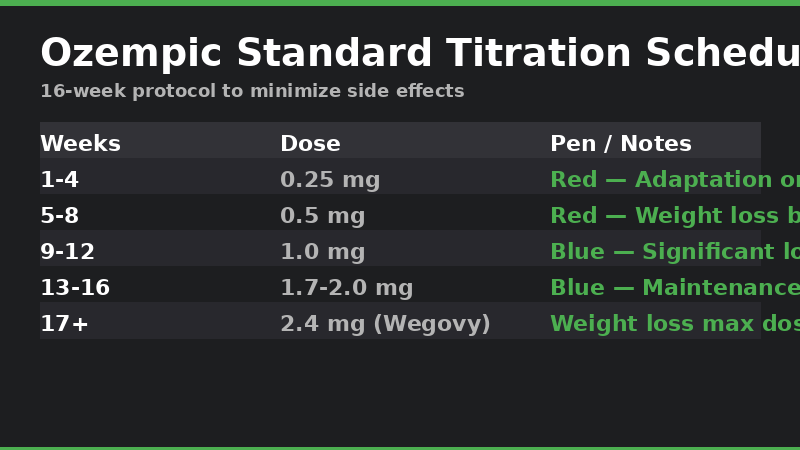
Standard 16-Week Titration Timeline
| Weeks | Dose | Pen Color | Notes |
|---|---|---|---|
| Weeks 1-4 | 0.25 mg | Red label | Starting dose. Not therapeutic — for adaptation only. |
| Weeks 5-8 | 0.5 mg | Red label | First therapeutic dose. Some weight loss may begin. |
| Weeks 9-12 | 1.0 mg | Blue label | Significant weight loss typically starts here. |
| Weeks 13-16+ | 1.7 mg (Wegovy) / 2.0 mg (Ozempic) | Blue/Yellow | Maintenance dose. Ozempic max is 2.0 mg. |
| Week 17+ | 2.4 mg | — | Wegovy only (max). Weight-loss-specific dose. |
Key difference for 2026: Ozempic (FDA-approved for type 2 diabetes) maxes out at 2.0 mg. Wegovy (FDA-approved for weight loss) goes to 2.4 mg. Both are semaglutide — same drug, different branding and maximum doses. Many doctors will prescribe Ozempic off-label to 2.0 mg for weight loss.
How Long at Each Dose?
The 4-week interval at each dose level isn’t arbitrary. A study by Wharton et al. in Diabetes, Obesity and Metabolism found that semaglutide’s GI side effects “most often occur during or shortly after dose escalation” and are transient — which is why the standard protocol waits 4 weeks between steps. DOI: 10.1111/dom.14551
Signs you’re ready to increase:
- Minimal or manageable nausea (≤2 on a 1-10 scale)
- Regular bowel movements for at least 5 consecutive days
- No vomiting in the past week
Signs you should stay at your current dose longer:
- Persistent nausea (≥4 on a 1-10 scale)
- Vomiting more than once per week
- Significant appetite suppression making it hard to eat enough calories
The 0.25 mg Starting Dose: What to Expect
The purpose of your first four weeks at 0.25 mg is simple: give your body time to adapt. Don’t expect significant weight loss — and that’s normal.
What 0.25 mg Actually Does
- Appetite: Mild to moderate reduction. You might notice you’re less interested in snacking.
- Fullness: Meals may feel more filling. You might eat 10-20% less without trying.
- Side effects: 35-45% of patients report mild nausea, especially in the first week. Fatigue is also common as your body adjusts to lower blood sugar.
- Weight loss: 1-3 pounds is typical in the first month. Some people lose nothing — this is completely normal.
Why You Can’t Jump to Higher Doses
The temptation to “get ahead” by moving to 0.5 mg or 1.0 mg early is understandable — who doesn’t want faster results? But skipping doses dramatically increases your risk of severe side effects.
In the STEP 1 trial, patients who started directly at higher doses had significantly more gastrointestinal adverse events — the titration protocol exists specifically to minimize this. PMID: 33567185
A slow start saves you from quitting.
The 0.5 mg Dose: Where Weight Loss Begins
At 0.5 mg, semaglutide reaches a concentration in your body where meaningful weight loss begins for most people. Clinical data shows average weight loss of 5-8% over 20 weeks at this dose.
What Changes at 0.5 mg
- Appetite suppression: Noticeable. You’ll feel full on smaller portions — often half of what you used to eat.
- Food noise: Many patients report a significant reduction in the constant thinking about food (“food noise”) at this dose.
- Side effects: Nausea may briefly reappear with the dose increase but typically resolves within 1-2 weeks.
- Weight loss rate: 1-2 pounds per week is common and healthy at this dose.
The “Sweet Spot” Dose
Interestingly, many patients don’t need to go beyond 0.5 mg to see meaningful weight loss. In the STEP 1 trial, patients at the 0.5 mg equivalent lost an average of 8-10% of body weight — enough for many to reach their goals without ever increasing.
If you’re consistently losing 1-2 pounds per week at 0.5 mg, there’s no urgency to increase. The right dose is the one that works for you, not the maximum on the label.
1.0 mg and Beyond: The Therapeutic Range
The 1.0 mg dose is where Ozempic’s full weight loss potential becomes apparent. In clinical trials, patients at 1.0 mg lost an average of 12-15% of body weight over 68 weeks.
Comparing Doses: Weight Loss Data
| Dose | Average Weight Loss | Patient Response |
|---|---|---|
| 0.25 mg | 1-3% | Adaptation phase — not therapeutic |
| 0.5 mg | 5-8% | Meaningful loss for many patients |
| 1.0 mg | 12-15% | Full therapeutic effect |
| 1.7-2.0 mg | 14-17% | Maximum Ozempic range |
| 2.4 mg (Wegovy) | 15-18% | Maximum semaglutide dose |
Data sourced from STEP trials and real-world clinical registries through 2025-2026.
When to Stop Titrating Up
You don’t have to reach the maximum dose. The goal is the lowest effective dose:
- Weight loss is steady (1-2 lbs/week) at your current dose → stay here
- Side effects are tolerable but you’re not losing → consider increasing
- Side effects are difficult at any dose → don’t increase, talk to your doctor
Missing a Dose: What to Do
If you miss a dose of Ozempic:
- Within 5 days of your scheduled dose: Take it as soon as you remember. Resume your normal schedule.
- More than 5 days late: Skip the missed dose. Take your next dose on the regularly scheduled day. Do not double up.
The 5-day window exists because semaglutide has a half-life of approximately 1 week. After 5 days, enough of the previous dose has cleared that catching up is less important than maintaining the routine.
Injection Tips for Better Results
Where to Inject
Ozempic can be injected into the abdomen, thigh, or upper arm. Rotate sites weekly. Some patients report fewer GI side effects when injecting in the thigh versus the abdomen — the data is anecdotal but the mechanism (slower absorption from thigh muscle) makes physiological sense.
Timing
Pick a consistent day of the week. Many patients choose Friday or Saturday so that if side effects occur, they peak over the weekend rather than during the work week.
After Injection
- Do not rub the injection site — this can increase absorption speed and worsen side effects
- If you see a drop of liquid on your skin after injecting, don’t worry — this is normal and the full dose was delivered
- Store unused pens in the refrigerator (36°F to 46°F). Once in use, a pen can be kept at room temperature for up to 56 days.
Summary
The Ozempic dosing journey is a marathon, not a sprint. The standard 16-week titration from 0.25 mg to 2.0 mg exists for a reason — it’s the schedule that balances effectiveness with tolerability for the most patients.
Key takeaways:
- Start at 0.25 mg and don’t rush — the first 4 weeks are for adaptation
- Most meaningful weight loss begins at 0.5 mg and above
- You don’t have to reach the maximum dose — find your effective dose
- Never adjust your dose without consulting your prescriber
- If you miss a dose by more than 5 days, just take the next scheduled one
The right dose is the one that helps you lose weight while keeping side effects manageable. That might be 0.5 mg, 1.0 mg, or 2.0 mg — the number matters less than the outcome.
References
- Wilding JPH, et al. “Once-Weekly Semaglutide in Adults with Overweight or Obesity.” New England Journal of Medicine. 2021. PMID: 33567185
- Wharton S, et al. “Gastrointestinal tolerability of once-weekly semaglutide 2.4 mg in adults with overweight or obesity.” Diabetes, Obesity and Metabolism. 2022. PMID: 34514682
- Rubino D, et al. “Effect of Weekly Subcutaneous Semaglutide vs Daily Liraglutide on Body Weight in Adults With Overweight or Obesity.” JAMA. 2022. PMID: 35015037
Last reviewed: June 14, 2026