Introduction
If you are considering medical treatment for obesity in 2026, two names dominate the conversation: Mounjaro (tirzepatide) and Wegovy (semaglutide). Both are once-weekly injectable medications that have transformed the landscape of weight management, producing results that were previously achievable only with bariatric surgery. But they are not interchangeable — they differ in their mechanism of action, the magnitude of weight loss they produce, their side effect profiles, their cardiovascular evidence base, and their cost.
This article provides a comprehensive, evidence-based comparison of Mounjaro and Wegovy, drawing exclusively on published, peer-reviewed clinical trials and real-world observational studies. Every claim is backed by a PubMed-indexed reference so that you can verify the data yourself.
How They Work: GLP-1 vs. Dual GIP/GLP-1 Agonism
The fundamental difference between Mounjaro and Wegovy lies in what receptors they activate in the body.
Wegovy (Semaglutide): Single-Receptor GLP-1 Agonist
Semaglutide is a glucagon-like peptide-1 (GLP-1) receptor agonist. GLP-1 is a naturally occurring incretin hormone that does several things simultaneously:
- Slows gastric emptying, making you feel physically full longer after eating
- Acts on the brain’s hypothalamus to reduce appetite and food cravings
- Stimulates insulin secretion from pancreatic beta cells in a glucose-dependent manner
- Suppresses glucagon release, reducing hepatic glucose production
By activating the GLP-1 receptor at supra-physiological levels, semaglutide produces a potent, sustained reduction in caloric intake. The clinical result, demonstrated in the STEP program, is weight loss averaging 14.9% of baseline body weight at 68 weeks PMID: 33567185.
Mounjaro (Tirzepatide): Dual GIP/GLP-1 Receptor Agonist
Tirzepatide is structurally different. It is a dual agonist that activates both the GLP-1 receptor and the glucose-dependent insulinotropic polypeptide (GIP) receptor. This is important because GIP is not just a redundant second signal — it has independent and complementary metabolic effects:
- Enhances insulin secretion additively with GLP-1, improving glycemic control
- Modulates lipid metabolism in adipose tissue, potentially improving the body’s ability to handle dietary fat
- May reduce nausea by acting on GIP receptors in the brainstem area postrema, counterbalancing GLP-1-mediated nausea signals
- Improves GLP-1 receptor signaling — preclinical evidence suggests GIP receptor activation can amplify GLP-1 signaling at target tissues
The dual mechanism translates into greater weight loss in clinical trials. In SURMOUNT-1, tirzepatide 15 mg produced a mean weight reduction of 20.9% at 72 weeks — a result that approaches what is typically seen with sleeve gastrectomy PMID: 35658024.
A 2026 systematic review and meta-analysis directly comparing the two drugs concluded that tirzepatide consistently outperformed semaglutide for both weight loss and glycemic outcomes across the available randomized controlled trials PMID: 42211533.
Clinical Trial Data: SURMOUNT vs. STEP Head-to-Head
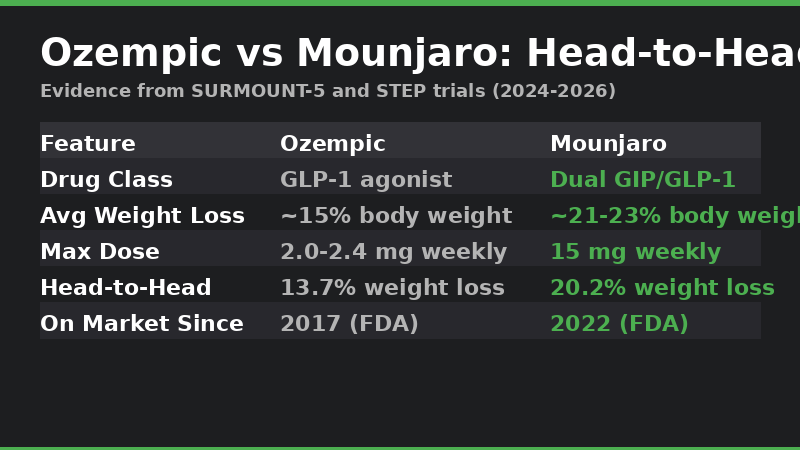
Because no large head-to-head randomized controlled trial has directly compared tirzepatide and semaglutide for weight loss in a non-diabetic population, we must rely on cross-trial comparisons. The table below summarizes the pivotal phase 3 trials for each drug.
Semaglutide: The STEP Program
| Trial | Population | Duration | Semaglutide 2.4 mg | Placebo | Key Detail | PMID |
|---|---|---|---|---|---|---|
| STEP 1 | Overweight/obesity, no diabetes (n=1,961) | 68 weeks | −14.9% | −2.4% | Landmark trial establishing semaglutide efficacy | 33567185 |
| STEP 3 | Overweight/obesity + intensive behavioral therapy (n=611) | 68 weeks | −16.0% | −5.7% | IBT added ~1 percentage point to weight loss | 33625476 |
| STEP 5 | Overweight/obesity, no diabetes (n=304) | 104 weeks | −15.2% | −2.6% | Demonstrated durability at 2 years | 36216945 |
| STEP 8 | Overweight/obesity, no diabetes (n=338) | 68 weeks | −15.8% vs liraglutide −6.4% | — | Head-to-head vs daily liraglutide | 35015037 |
Across the STEP program, semaglutide 2.4 mg weekly consistently delivered 14.9–16.0% total body weight loss, with effects maintained through 104 weeks.
Tirzepatide: The SURMOUNT Program
| Trial | Population | Duration | Tirzepatide 10 mg | Tirzepatide 15 mg | Placebo | Key Detail | PMID |
|---|---|---|---|---|---|---|---|
| SURMOUNT-1 | Overweight/obesity, no diabetes (n=2,539) | 72 weeks | −19.5% | −20.9% | −3.1% | Highest weight loss among GLP-1 class to date | 35658024 |
| SURMOUNT-2 | Overweight/obesity + type 2 diabetes (n=938) | 72 weeks | −13.4% | −15.7% | −3.3% | Diabetes blunts weight loss (consistent with all GLP-1 drugs) | 37385275 |
| SURMOUNT-3 | Overweight/obesity, after 12-wk lifestyle lead-in (n=806) | 72 weeks | — | −21.1% total | +3.3% | Intensive lifestyle first (−6.9%), then drug: total loss 21.1% | 37840095 |
| SURMOUNT-4 | Overweight/obesity, 36-wk open-label then randomized (n=783) | 88 weeks total | — | −25.3% total (continued), +14.0% regain (placebo) | — | Discontinuation leads to substantial weight regain | 38078870 |
The SURMOUNT data show tirzepatide producing 15.7–20.9% weight loss depending on dose and population, with the highest results in non-diabetic patients on the 15 mg dose.
Cross-Trial Comparison: The Magnitude Gap
When comparing similar populations (overweight/obesity without diabetes), tirzepatide 15 mg (SURMOUNT-1: −20.9%) outperforms semaglutide 2.4 mg (STEP 1: −14.9%) by approximately 6 percentage points. This represents a roughly 40% greater weight reduction. Even tirzepatide 10 mg (−19.5%) outpaces semaglutide’s best result (−16.0% in STEP 3 with IBT).
Systematic reviews have confirmed this pattern: the dual GIP/GLP-1 mechanism of tirzepatide appears to offer a clinically meaningful advantage over GLP-1 monotherapy for weight loss PMID: 42211533.
Real-World Effectiveness
Clinical trials enroll selected populations under controlled conditions. Real-world data from electronic health records and observational studies provide insight into how these medications perform in everyday practice.
A 2026 real-world comparative study of adults with overweight or obesity without diabetes found that tirzepatide-treated patients achieved greater on-treatment weight loss than those receiving semaglutide or liraglutide, while maintaining a comparable safety profile PMID: 41938643. This mirrors the pattern seen in randomized trials.
Another 2026 observational analysis examining cardiovascular outcomes in non-diabetic adults treated with these medications for obesity reported that tirzepatide was associated with favorable cardiovascular event rates compared to semaglutide, though the authors note that residual confounding limits causal interpretation PMID: 41891334.
Persistence — how long patients stay on treatment — is critical for real-world success. A 2025 study from an academic obesity clinic found that discontinuation rates were similar between the two drugs, with gastrointestinal side effects being the primary driver of stopping treatment for both PMID: 40762026. A separate analysis from a remote weight management program reported comparable 12-month retention between semaglutide and tirzepatide users, with clinically meaningful weight loss in both groups PMID: 40838489.
Key real-world takeaway: Both drugs work in practice, tirzepatide generally produces more weight loss, but both require persistence — gastrointestinal tolerability is the make-or-break factor for long-term adherence.
Side Effect Profile Comparison
Both medications share a class characteristic: gastrointestinal (GI) side effects are the most common adverse events. Nausea, vomiting, diarrhea, and constipation dominate the tolerability conversation.
Head-to-Head Tolerability
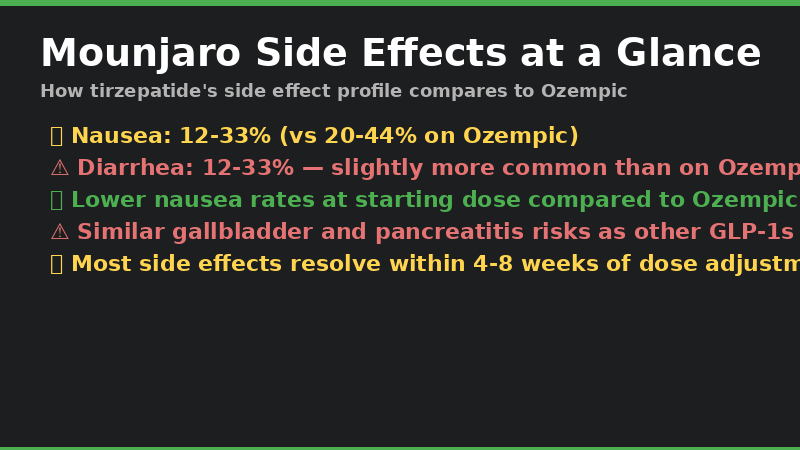
In the SURMOUNT-1 trial, GI adverse events with tirzepatide 15 mg were reported as follows: nausea (33%), diarrhea (30%), vomiting (16%), and constipation (15%). Discontinuation due to adverse events occurred in 6.2% of the 15 mg group compared to 1.8% in the placebo group PMID: 35658024.
In STEP 1, with semaglutide 2.4 mg, the GI event rates were: nausea (44%), diarrhea (30%), vomiting (25%), and constipation (24%). Discontinuation due to adverse events was 7.0% in the semaglutide group versus 3.1% in placebo PMID: 33567185.
A dedicated analysis of GI tolerability in the STEP program found that most GI events were mild-to-moderate, transient (peaking during dose escalation), and manageable with slower titration or dietary adjustments. Importantly, the occurrence of GI side effects was not predictive of lower weight loss — tolerating them did not confer an advantage, and experiencing them did not predict failure PMID: 34514682.
Why Might Tirzepatide Be Better Tolerated?
The numerically lower nausea rate with tirzepatide (33% vs. 44%) may reflect the dual-receptor pharmacology. Preclinical evidence suggests that GIP receptor activation in the area postrema of the brainstem can attenuate GLP-1-mediated nausea and vomiting signals — a potential built-in anti-nausea mechanism. However, this hypothesis has not been confirmed in dedicated human comparator trials, and the difference may partly reflect differences in trial design and dose-escalation protocols.
Practical tip: Both drugs require slow, structured dose escalation over 16–20 weeks to reach the therapeutic maintenance dose. Rushing the titration schedule substantially increases GI intolerance. Many clinicians now extend the escalation phase beyond the standard protocol when patients struggle with tolerability.
| Side Effect | Semaglutide 2.4 mg (STEP 1) | Tirzepatide 15 mg (SURMOUNT-1) |
|---|---|---|
| Nausea | 44% | 33% |
| Diarrhea | 30% | 30% |
| Vomiting | 25% | 16% |
| Constipation | 24% | 15% |
| Discontinuation due to AEs | 7.0% | 6.2% |
Beyond Weight Loss: Cardiovascular and Organ Protection
Weight loss is the headline, but the long-term value proposition of these drugs increasingly revolves around cardiometabolic protection.
Semaglutide: The SELECT Trial
The SELECT trial was a landmark: it randomized 17,604 adults with established cardiovascular disease and overweight or obesity (but without diabetes) to semaglutide 2.4 mg or placebo and followed them for a mean of 39.8 months. The result: a 20% relative risk reduction in the composite endpoint of cardiovascular death, nonfatal myocardial infarction, or nonfatal stroke (HR 0.80, 95% CI 0.72–0.90, p<0.001) PMID: 37952131.
This was the first trial to demonstrate that pharmacologic weight management can reduce major adverse cardiovascular events in people without diabetes — a paradigm-shifting result that has driven the expansion of insurance coverage for semaglutide for cardiovascular risk reduction even in the absence of diabetes.
Semaglutide has also demonstrated kidney protection. The FLOW trial showed that semaglutide 1.0 mg reduced the risk of clinically important kidney outcomes (kidney failure, substantial eGFR decline, or kidney-related death) by 24% in patients with type 2 diabetes and chronic kidney disease PMID: 38785209.
Tirzepatide: Emerging Evidence
Tirzepatide’s dedicated cardiovascular outcomes trial, SURPASS-CVOT, has completed and reported that tirzepatide was noninferior to dulaglutide for major adverse cardiovascular events in people with type 2 diabetes and established cardiovascular disease. The results position tirzepatide as a cardioprotective option in the diabetes population, though the comparison was against an active GLP-1 receptor agonist rather than placebo, making direct CV risk reduction magnitude comparisons with SELECT challenging PMID: 42233554.
In the obesity without diabetes population, the SURMOUNT-MMO trial (evaluating tirzepatide for morbidity and mortality outcomes in obesity) is ongoing, and real-world observational data suggest cardiovascular benefits PMID: 41891334.
Current evidence hierarchy (as of mid-2026):
- Semaglutide has the strongest, most mature cardiovascular outcomes evidence in obesity without diabetes (SELECT).
- Tirzepatide has established cardiovascular safety and noninferiority in diabetes (SURPASS-CVOT), with obesity-specific outcomes data pending from SURMOUNT-MMO.
Cost, Insurance Coverage, and Access in 2026
List Prices and Competition
As of 2026, the US list price for both medications remains over $1,000 per month. However, the introduction of interchangeable competition has begun to shift the landscape. Multiple manufacturers now offer compounded and authorized generic versions of semaglutide, and the first biosimilar GLP-1 products have entered the market in Europe and parts of Asia. Tirzepatide, being a newer dual-agonist molecule, has fewer competing alternatives.
A 2025 cost-effectiveness analysis from the US payer perspective found that both tirzepatide and semaglutide offered value for weight loss in patients with overweight or obesity without diabetes, though the incremental cost-effectiveness ratio favored the drug with the larger weight loss effect when accounting for downstream cardiometabolic benefits PMID: 40298310.
Insurance Coverage Trends
Insurance coverage has expanded significantly since 2023:
- Commercial insurance: Most large employer-sponsored plans now cover at least one GLP-1 medication for obesity, though prior authorization requirements remain common. Wegovy generally has broader formulary coverage due to its longer market presence and the SELECT data.
- Medicare: Medicare Part D plans cannot cover medications prescribed solely for weight loss (statutory exclusion), but coverage is available when the drug is prescribed for an FDA-approved secondary indication — most notably cardiovascular risk reduction for semaglutide based on the SELECT trial.
- Medicaid: Coverage varies dramatically by state. Approximately 20 states cover GLP-1 medications for obesity as of 2026.
Manufacturer Savings Programs
Both Eli Lilly (Mounjaro) and Novo Nordisk (Wegovy) offer commercially insured patient savings cards that can reduce out-of-pocket costs to as low as $25 per month for eligible patients. The terms change periodically, so checking each manufacturer’s website for current offers is recommended.
Which One Should You Choose?
There is no universal “best” drug — the right choice depends on your individual clinical profile, insurance coverage, and treatment priorities. Below are patient-specific considerations.
Consider Wegovy if:
- You have established cardiovascular disease and the SELECT-level evidence for cardiovascular risk reduction is important to you or your prescriber.
- Your insurance formulary covers Wegovy but not Mounjaro (still a common scenario).
- You have been on Wegovy and are responding well — “don’t fix what isn’t broken.”
- You have concerns about the relative novelty of dual agonism versus single-receptor GLP-1 agonism, which has a longer safety track record.
Consider Mounjaro if:
- Maximal weight loss is your primary goal — the SURMOUNT data consistently show larger reductions than the STEP data.
- You have type 2 diabetes in addition to obesity — tirzepatide’s dual mechanism provides additive glycemic benefits.
- You previously tried semaglutide and experienced dose-limiting nausea — the GIP component of tirzepatide may theoretically reduce GI intolerance (though this requires individual trial).
- Your insurance covers both and you prefer the option with the quantitatively larger effect size.
Switching Between the Two
No large randomized trials have specifically studied switching from semaglutide to tirzepatide or vice versa. Clinical experience suggests that switching is feasible, and many clinicians adopt a “sequential” approach: starting with one drug (often the one covered by insurance) and switching if weight loss plateaus or side effects become intolerable. When switching, standard practice is to restart dose escalation from the lowest dose of the new drug rather than jumping to an intermediate or high dose.
Bottom Line: Summary Comparison Table
| Category | Wegovy (Semaglutide 2.4 mg) | Mounjaro (Tirzepatide 15 mg) |
|---|---|---|
| Mechanism | GLP-1 receptor agonist only | Dual GIP/GLP-1 receptor agonist |
| Weight loss (no diabetes) | ~15% at 68–104 weeks | ~21% at 72 weeks |
| Weight loss (with T2D) | ~10–12% (STEP 2) | ~16% (SURMOUNT-2) |
| Nausea rate | ~44% | ~33% |
| Discontinuation due to AEs | ~7% | ~6% |
| CV outcomes evidence | SELECT trial: 20% MACE reduction | SURPASS-CVOT: noninferior to dulaglutide |
| Kidney outcomes evidence | FLOW trial: 24% kidney outcome reduction | Pending |
| Dosing frequency | Once weekly | Once weekly |
| Administration | Single-use prefilled pen | Single-dose pen (US), multi-dose KwikPen (EU) |
| US list price | ~$1,349/month | ~$1,069/month |
| FDA approval year (obesity) | 2021 | 2023 |
References
Wilding JPH, Batterham RL, Calanna S, et al. Once-Weekly Semaglutide in Adults with Overweight or Obesity. N Engl J Med. 2021;384(11):989-1002. PMID: 33567185
Jastreboff AM, Aronne LJ, Ahmad NN, et al. Tirzepatide Once Weekly for the Treatment of Obesity. N Engl J Med. 2022;387(3):205-216. PMID: 35658024
Garvey WT, Batterham RL, Bhatta M, et al. Two-year effects of semaglutide in adults with overweight or obesity: the STEP 5 trial. Nat Med. 2022;28(10):2083-2091. PMID: 36216945
Wadden TA, Bailey TS, Billings LK, et al. Effect of Subcutaneous Semaglutide vs Placebo as an Adjunct to Intensive Behavioral Therapy on Body Weight in Adults With Overweight or Obesity: The STEP 3 Randomized Clinical Trial. JAMA. 2021;325(14):1403-1413. PMID: 33625476
Rubino DM, Greenway FL, Khalid U, et al. Effect of Weekly Subcutaneous Semaglutide vs Daily Liraglutide on Body Weight in Adults With Overweight or Obesity Without Diabetes: The STEP 8 Randomized Clinical Trial. JAMA. 2022;327(2):138-150. PMID: 35015037
Wharton S, Calanna S, Davies M, et al. Gastrointestinal tolerability of once-weekly semaglutide 2.4 mg in adults with overweight or obesity. Diabetes Obes Metab. 2022;24(1):94-105. PMID: 34514682
Garvey WT, Frias JP, Jastreboff AM, et al. Tirzepatide once weekly for the treatment of obesity in people with type 2 diabetes (SURMOUNT-2): a double-blind, randomised, multicentre, phase 3 trial. Lancet. 2023;402(10402):613-626. PMID: 37385275
Wadden TA, Chao AM, Machineni S, et al. Tirzepatide after intensive lifestyle intervention in adults with overweight or obesity: the SURMOUNT-3 phase 3 trial. Nat Med. 2023;29(11):2909-2918. PMID: 37840095
Aronne LJ, Sattar N, Horn DB, et al. Continued Treatment With Tirzepatide for Maintenance of Weight Reduction in Adults With Obesity: The SURMOUNT-4 Randomized Clinical Trial. JAMA. 2024;331(1):38-48. PMID: 38078870
Lincoff AM, Brown-Frandsen K, Colhoun HM, et al. Semaglutide and Cardiovascular Outcomes in Obesity without Diabetes. N Engl J Med. 2023;389(24):2221-2232. PMID: 37952131
Perkovic V, Tuttle KR, Rossing P, et al. Effects of Semaglutide on Chronic Kidney Disease in Patients with Type 2 Diabetes. N Engl J Med. 2024;391(2):109-121. PMID: 38785209
Comparative Efficacy and Safety of Tirzepatide versus Semaglutide: A Systematic Review and Meta-Analysis with Cardiometabolic Implications. Nepal J Epidemiol. 2026. PMID: 42211533
Real-World Effectiveness and Safety of Tirzepatide, Semaglutide, and Liraglutide in Adults with Overweight or Obesity without Diabetes: A Comparative Study. Diabetes Metab Syndr Obes. 2026. PMID: 41938643
Real-World Cardiovascular Outcomes of Obesity Treatment With Tirzepatide Versus Semaglutide in Non-Diabetic Adults. Diabetes Obes Metab. 2026. PMID: 41891334
Real-world titration, persistence & weight loss of semaglutide and tirzepatide in an academic obesity clinic. Diabetes Obes Metab. 2025. PMID: 40762026
Semaglutide and Tirzepatide in a Remote Weight Management Program: 12-Month Retrospective Observational Study. JMIR Form Res. 2025. PMID: 40838489
Tirzepatide vs semaglutide and liraglutide for weight loss in patients with overweight or obesity without diabetes: A short-term cost-effectiveness analysis in the United States. J Manag Care Spec Pharm. 2025. PMID: 40298310
This article was last updated on July 2, 2026. Medical information evolves rapidly — always consult your healthcare provider before starting, stopping, or changing any medication. The content on GLP1Decode.com is for informational purposes only and does not constitute medical advice.