Introduction
Mounjaro (tirzepatide) is one of the most effective weight-loss medications available in 2026. Among prescription weight loss injectables, it currently produces the largest average weight reduction. The SURMOUNT-1 trial showed an average weight loss of 22.5% at the highest dose – results that reset what doctors thought possible with medication [1]. But effectiveness comes with side effects. Most are temporary and manageable. A few are serious and need immediate attention. This guide tells you which is which.
Tirzepatide works differently from older GLP-1 drugs like Ozempic. It activates two receptors – GLP-1 and GIP. That dual action is why Mounjaro produces more weight loss. It may also explain why the side effect pattern is not identical to what you see with semaglutide.
Medical Disclaimer: This article provides general information. It does not replace medical advice. Talk to your doctor before starting, stopping, or changing any medication.
Common side effects: what most people experience
The SURMOUNT clinical trials tracked side effects across thousands of participants. The most common ones affect the digestive system. They are usually mild to moderate and get better over time.
Nausea
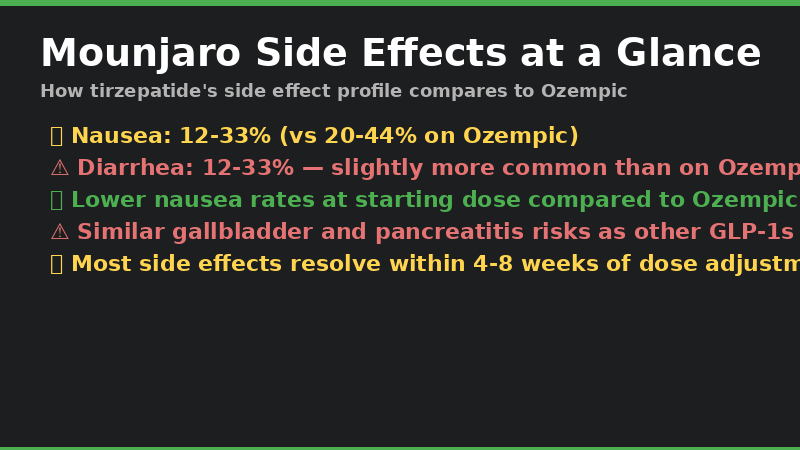
Nausea is the most frequently reported side effect of Mounjaro. In SURMOUNT-1, 25% to 33% of people on tirzepatide (across the 5mg, 10mg, and 15mg doses) reported nausea, compared to 9.5% on placebo [1]. SURMOUNT-2, which studied people with type 2 diabetes and obesity, found similar rates – 22% to 27% across doses [2].
The nausea has a clear cause. Tirzepatide slows gastric emptying. Food sits in your stomach longer. The drug also acts on the brainstem, where the nausea center lives. These two effects combine to make you feel queasy, especially after eating.
Most people adapt. Nausea peaks during the first month and decreases noticeably by weeks 8 to 12. That is exactly why Mounjaro uses a gradual dose escalation – starting at 2.5mg and moving up every 4 weeks.
What helps:
- Eat smaller meals. Five or six small ones beat three large ones.
- Avoid greasy and fried foods. Fat makes gastric emptying even slower.
- Sip water all day. Do not chug large amounts at once.
- Ginger tea or ginger chews can settle your stomach.
- Inject at night before bed. You sleep through the worst of it.
- Ask your doctor about a slower dose increase if nausea is severe.
Diarrhea
In the SURMOUNT program, diarrhea affected 17% to 23% of tirzepatide users, compared to 6% to 10% on placebo [1,2]. It tends to be worse during the first few days after an injection and improves as the week goes on.
Stay hydrated. Electrolyte drinks help more than plain water when you are losing fluids. The BRAT diet – bananas, rice, applesauce, toast – gives your gut a break during bad episodes. Most people find that diarrhea settles down after the first 4 to 8 weeks on a stable dose.
Vomiting
Vomiting is less common than nausea but still affects roughly 8% to 13% of people on Mounjaro in clinical trials [1,3]. It often happens when someone eats a large meal or a high-fat meal while on the medication. The slowed stomach emptying means that food has nowhere to go, and the body’s response is to get rid of it.
Prevention works better than treatment here. Do not test your limits. Stop eating when you feel full – do not finish the plate because you used to be able to. If vomiting continues for more than 24 hours, call your doctor. Dehydration is a real risk.
Constipation
About 12% to 17% of Mounjaro users report constipation [2,3]. The slow-down effect on gut motility that causes nausea also slows the transit of stool. Increase your fiber intake gradually – too fast and you will add bloating on top of constipation. Aim for 25 to 30 grams of fiber daily. Psyllium husk is effective. Drink enough water, because fiber without water makes constipation worse.
Fatigue
Fatigue does not appear in every clinical trial table, but patient communities consistently rank it among the top complaints. Your body is running on fewer calories. That energy deficit hits some people hard, especially in the first 6 to 8 weeks. Eating enough protein (at least 1.2 grams per kilogram of body weight) helps. So does staying hydrated. The tiredness usually lifts once your body adapts to the calorie reduction.
Serious side effects: what you need to know
Most Mounjaro side effects are uncomfortable but not dangerous. Some are rare but serious. You need to recognize them.
Pancreatitis
GLP-1 receptor agonists carry a warning for acute pancreatitis. In the SURMOUNT-1 trial, pancreatitis occurred in 0.2% of participants on tirzepatide [1]. That is rare. But it is a medical emergency when it happens.
The warning sign is severe abdominal pain that radiates to the back, often with nausea and vomiting that does not stop. Do not wait. Go to an emergency room. Tell them you are on Mounjaro.
Gallbladder Disease
Weight loss itself increases gallbladder risk, regardless of the method. Rapid weight loss makes the liver secrete extra cholesterol into bile, raising the chance of gallstones. The SURMOUNT trials reported cholecystitis (gallbladder inflammation) and cholelithiasis (gallstones) in a small percentage of participants [1,3].
Signs to watch for: pain in the upper right abdomen, especially after eating. Pain between the shoulder blades. Nausea with these pain patterns. Your doctor can check with an ultrasound.
Thyroid C-Cell Tumors
Mounjaro carries a boxed warning about thyroid C-cell tumors, based on rodent studies. In rats, tirzepatide caused dose-dependent thyroid C-cell tumors. We do not know if this happens in humans. No human cases have been confirmed in clinical trials to date.
Because of this uncertainty, Mounjaro is not recommended for anyone with a personal or family history of medullary thyroid carcinoma (MTC) or Multiple Endocrine Neoplasia syndrome type 2 (MEN 2). Report any lump in the neck, hoarseness, trouble swallowing, or shortness of breath to your doctor.
Kidney Injury
Severe vomiting or diarrhea can cause dehydration. Dehydration can lead to acute kidney injury. This is not a direct drug effect – it is a consequence of fluid loss. In clinical trials, kidney-related adverse events were uncommon but more frequent in the tirzepatide groups than placebo [4]. The prevention is simple. If you have vomiting or diarrhea, drink electrolyte solutions. If you cannot keep fluids down, get medical help.
Hypoglycemia
Mounjaro alone does not cause dangerous low blood sugar in people without diabetes. But if you are also taking sulfonylureas or insulin, the risk is real. SURMOUNT-2, which enrolled people with type 2 diabetes, reported hypoglycemia in 4% to 8% of participants on tirzepatide [2]. Your doctor should adjust your other diabetes medications when you start Mounjaro.
Mounjaro vs ozempic: comparing side effect profiles
People often ask which drug has worse side effects. The answer is not straightforward. Both cause GI issues. The pattern differs slightly.
A 2026 indirect comparison of tirzepatide and oral semaglutide for weight loss found that tirzepatide had somewhat higher rates of nausea overall – consistent with its stronger weight-loss effect [5]. But this comparison is complicated by the fact that injectable semaglutide (Ozempic/Wegovy) and oral semaglutide (Rybelsus) have different absorption profiles.
The SURMOUNT-5 trial directly compared tirzepatide to semaglutide for obesity. A post hoc analysis published in 2026 looked at safety alongside efficacy [6]. Both drugs caused gastrointestinal side effects at broadly similar rates at equivalent weight-loss doses. Semaglutide users reported slightly more constipation. Tirzepatide users reported slightly more nausea and diarrhea. These differences were small and may not matter for any individual patient.
What does matter: Mounjaro produces more weight loss on average. For many people, that benefit outweighs a modest increase in GI side effects. But if you have a particularly sensitive stomach, the semaglutide option may be easier to tolerate. This is a conversation to have with your doctor, not something to decide from a chart.
A 2026 nutritional analysis of SURMOUNT-1 through 4 found that tirzepatide users experienced meaningful reductions in calorie intake without significant nutritional deficiencies when diet quality was maintained [7]. The side effects may actually help reinforce healthier eating patterns over time.
Side effect timeline by dose
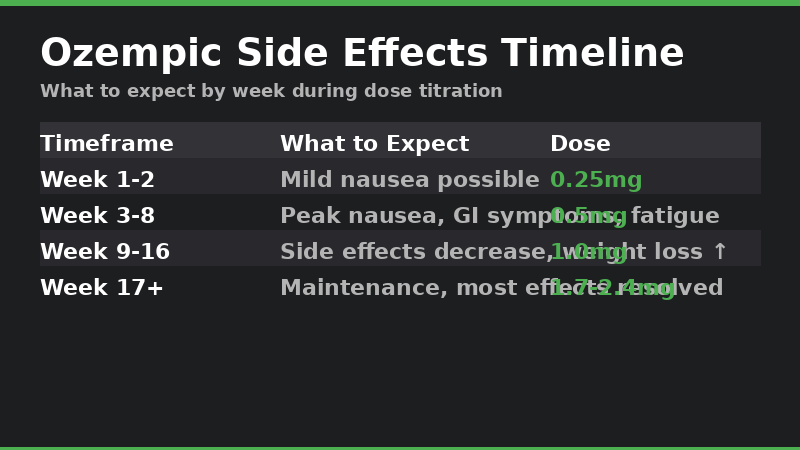
The Mounjaro dosing schedule moves through six dose levels: 2.5mg, 5mg, 7.5mg, 10mg, 12.5mg, and 15mg. Each step up is separated by at least 4 weeks.
Weeks 1-4 (2.5mg): This is the starter dose. It is not therapeutic for most people. The goal is introducing your body to the drug. Side effects are usually mild here. Some people feel nothing. Others notice slight nausea or changes in appetite.
Weeks 5-8 (5mg): The first therapeutic dose. Side effects often appear or increase at this step. Nausea and diarrhea are most common. The SURMOUNT trials showed that side effects peak around the transition to higher doses and then decrease [1,2].
Weeks 9-16 (7.5mg and 10mg): Your body has been on the medication for two to three months by now. GI side effects typically level off or decline. Weight loss is usually accelerating.
Weeks 17+ (12.5mg and 15mg): By this point, most people tolerate the medication well. The SURMOUNT-4 trial showed that continued treatment maintained the side effect improvement – problems did not return at steady-state dosing [4]. New side effects at this stage (especially abdominal pain) should be evaluated, since gallbladder issues may emerge after sustained weight loss.
The key pattern: side effects get worse with each dose increase, then improve within 2 to 4 weeks. If a dose jump is too rough, your doctor can keep you at the current dose longer or go back down temporarily. The right dose is the one you tolerate and that works for you. You do not have to reach 15mg.
When to call your doctor
Call your doctor if:
- You cannot keep fluids down for 24 hours.
- You have severe abdominal pain, especially if it goes through to your back.
- Your stool is pale or clay-colored, or your urine is dark (possible gallbladder or liver issues).
- You notice a lump in your neck or persistent hoarseness.
- You have signs of an allergic reaction: rash, swelling of the face or throat, difficulty breathing.
Less urgent but worth a call:
- Side effects that prevent you from eating adequately for more than a few days.
- Diarrhea that lasts more than a week without improvement.
- Any new symptom that worries you. Trust your instincts.
Summary
Mounjaro side effects are real. Most of them center on the digestive system. Nausea, diarrhea, vomiting, and constipation affect a significant minority of users. They peak during early treatment and after dose increases. They usually improve.
Serious side effects are rare. Pancreatitis, gallbladder disease, and thyroid concerns deserve respect but not panic. The absolute risk is low. The key is knowing the warning signs and acting quickly if they appear.
Tens of thousands of people have taken tirzepatide in clinical trials. The safety profile is well-characterized. For most people, the benefits of significant weight loss outweigh the manageable GI side effects. Go slowly with your dose. Listen to your body. Stay in touch with your doctor.
References
Jastreboff AM, Aronne LJ, Ahmad NN, et al. Tirzepatide Once Weekly for the Treatment of Obesity. N Engl J Med. 2022;387(3):205-216. PMID: 35658024.
Garvey WT, Frias JP, Jastreboff AM, et al. Tirzepatide once weekly for the treatment of obesity in people with type 2 diabetes (SURMOUNT-2): a double-blind, randomised, multicentre, placebo-controlled, phase 3 trial. Lancet. 2023;402(10402):613-626. PMID: 37385275.
Wadden TA, Chao AM, Machineni S, et al. Tirzepatide after intensive lifestyle intervention in adults with overweight or obesity: the SURMOUNT-3 phase 3 trial. Nat Med. 2023;29(11):2909-2918. PMID: 37840095.
Aronne LJ, Sattar N, Horn DB, et al. Continued Treatment With Tirzepatide for Maintenance of Weight Reduction in Adults With Obesity: The SURMOUNT-4 Randomized Clinical Trial. JAMA. 2024;331(1):38-48. PMID: 38078870.
Ciudin A, Johansson E, Zimner-Rapuch S, et al. Indirect Comparative Efficacy and Safety of Tirzepatide Versus Oral Semaglutide for the Treatment of Overweight and Obesity. Diabetes Obes Metab. 2026;28(7):6162-6171. PMID: 42050884.
Aronne LJ, Horn DB, Kokkinos AD, et al. Relationship of early rapid weight loss to efficacy and safety of tirzepatide and semaglutide for obesity: SURMOUNT-5 post hoc analysis. Am J Med. 2026;139(7):913-921. PMID: 41865857.
Almandoz JP, Pickett-Blakely O, Tewksbury C, et al. Nutritional status with tirzepatide in obesity: A post hoc analysis of the SURMOUNT-1-4 randomized clinical trials. Obes Pillars. 2026;17:100248. PMID: 41640675.