Medical Disclaimer: This article is for informational purposes only and does not constitute medical advice. Ozempic (semaglutide) is a prescription medication that requires evaluation by a licensed healthcare provider. Do not start, stop, or change any medication without consulting your doctor. Weight loss medications carry risks including nausea, vomiting, pancreatitis, and thyroid C-cell tumors (observed in rodents). Discuss your full medical history with a provider before pursuing any treatment.
Introduction
Ozempic has become one of the most talked-about medications in the United States, for type 2 diabetes, where it earned FDA approval in 2017, and for the weight loss results patients report while taking it. As one of the most prescribed weight loss injectables in the country, semaglutide sits at the center of a growing conversation about who should have access to these drugs. That clinical overlap has created a messy reality: many people who want Ozempic for weight loss face roadblocks, while others with diabetes navigate prior authorizations and supply shortages. The result is confusion about who can actually get a prescription, and how.
This guide walks through the concrete steps. It covers the clinical criteria prescribers use, the difference between Ozempic and Wegovy (same drug, different labels, different insurance rules), what happens during an in-person visit, how telehealth platforms have changed access, and what to do if your insurance says no. Every recommendation here reflects what practicing clinicians and pharmacists deal with in 2026, not aspirational advice.
Who qualifies for an Ozempic prescription?
Ozempic carries an FDA indication for type 2 diabetes, and that is the diagnosis most payers require before they will cover it. A provider can write an off-label prescription for weight loss, but without a diabetes diagnosis on file, insurance coverage becomes unlikely. Here is what clinicians actually evaluate.
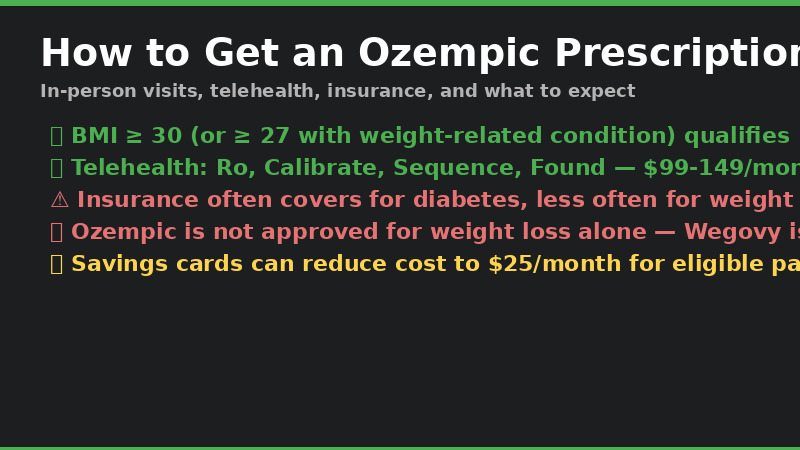
BMI thresholds and comorbidities. Ozempic’s on-label use requires a confirmed diagnosis of type 2 diabetes, typically with an HbA1c of 6.5% or above. For weight loss, prescribing guidelines generally follow the Wegovy model: a BMI of 30 or higher (obesity), or 27 or higher (overweight) with at least one weight-related comorbidity such as hypertension, dyslipidemia, or obstructive sleep apnea. In practice, many endocrinologists and primary care doctors apply these same thresholds when considering off-label semaglutide, since they mirror the criteria from the STEP trials that established the drug’s weight-loss efficacy [1].
Lab work you should expect. Before writing a prescription, most providers will order a metabolic panel, HbA1c, lipid panel, and thyroid function tests. They are screening for undiagnosed diabetes, ruling out contraindications like medullary thyroid carcinoma or MEN2, and establishing a baseline for tracking. If your HbA1c comes back in the prediabetic range (5.7%–6.4%), some clinicians will still prescribe, but the insurance battle gets harder.
Contraindications that block a prescription. A personal or family history of medullary thyroid carcinoma or Multiple Endocrine Neoplasia syndrome type 2 is an absolute contraindication. A history of pancreatitis raises serious concern, though it is not an automatic exclusion. Pregnancy, planned pregnancy, and breastfeeding are contraindications. If you have gastroparesis or severe GI motility issues, most prescribers will hesitate because GLP-1 agonists slow gastric emptying, which can worsen those conditions.
The real-world picture. Real-world data from the Danish national registries, covering GLP-1 receptor agonist use among adolescents and young adults from 2018 to 2025, shows prescription rates have increased substantially, but still concentrate among those with obesity-related comorbidities [2]. In rheumatology settings, semaglutide and tirzepatide initiation patterns tracked closely with BMI and metabolic syndrome markers rather than with patient preference alone [3]. What that tells you: clinicians make prescribing decisions based on objective criteria, not demand. Walking into an appointment knowing your numbers helps.
Ozempic vs wegovy: which gets prescribed?
Semaglutide is the active ingredient in both Ozempic and Wegovy. The drugs are chemically identical. What separates them is labeling, dosing, and insurance coverage architecture, and those differences dictate which one your doctor reaches for.
Ozempic (semaglutide injection, 0.25 mg, 0.5 mg, 1.0 mg, 2.0 mg). FDA-approved for type 2 diabetes. Typically started at 0.25 mg weekly and titrated up to 0.5 mg or 1.0 mg for glycemic control, with a 2.0 mg maximum dose approved in 2022. Most commercial and Medicare Part D plans cover Ozempic for diabetes, though prior authorization is common.
Wegovy (semaglutide injection, 2.4 mg). FDA-approved for chronic weight management in adults with obesity or overweight with at least one weight-related comorbidity. The 2.4 mg maintenance dose is higher than Ozempic’s typical diabetes dosing. Employer-sponsored insurance often excludes weight loss medications entirely, a 2024 analysis found roughly 40% of large employer plans do not cover anti-obesity medications. Medicare Part D is legally barred from covering weight-loss drugs, though legislative efforts to change that continue.
How the choice plays out in the exam room. If you have type 2 diabetes, your doctor writes for Ozempic because it is on-label and your insurance is likely to cover it. If you want semaglutide solely for weight loss and you have commercial insurance that covers obesity medications, Wegovy is the on-label choice. In cases where insurance covers neither, some patients pay cash for compounded semaglutide from compounding pharmacies, a practice the FDA has warned about due to quality and safety concerns. Others use manufacturer savings programs, which for Wegovy can bring the monthly cost to roughly $650–850 instead of the $1,350 list price.
The distinction matters because insurance prior authorization systems are binary: if the diagnosis code does not match the FDA label, the claim often rejects automatically. Your doctor knowing to submit a type 2 diabetes code with Ozempic or an obesity code with Wegovy is the difference between approval and denial.
In-Person doctor visit: what to expect
Going through your primary care provider or an endocrinologist is still the most common route to an Ozempic prescription. Telehealth has grown fast, but for patients with complex medical histories, an in-person visit remains the standard, and some insurers require it.
Before the appointment. Gather your recent lab results, a list of current medications (including over-the-counter supplements), and your weight history, including previous weight-loss attempts and their outcomes. Insurance companies often want documentation that you have tried lifestyle modification (diet, exercise, structured programs) before approving a GLP-1 agonist. If you have records from a registered dietitian or a commercial program like WeightWatchers or Noom, bring them. A narrative review published in the Journal of the American Pharmacists Association emphasizes that comprehensive patient history, including prior weight-management strategies and medication tolerance, directly informs whether semaglutide is appropriate and whether an insurer will cover it [4].
During the appointment. Be direct. Tell the doctor you are interested in Ozempic or semaglutide and explain why, weight loss, glycemic control, cardiovascular risk reduction, or a combination. Ask what criteria they use to determine candidacy. A good clinician will discuss the full picture: expected benefits, common side effects (nausea affects roughly 20% of users during titration, though it typically subsides), the long-term nature of treatment (most patients regain weight after stopping), and the commitment required for dose escalation.
What they will check. Expect a physical exam that includes weight, blood pressure, and often a waist circumference measurement. They will review any history of thyroid nodules, pancreatitis, gallbladder disease, or diabetic retinopathy, all of which can influence the risk-benefit calculus. If you do not have recent labs (within 3–6 months), they will order them before writing the prescription.
Follow-up cadence. Most prescribers schedule a follow-up at 4–6 weeks to assess tolerability and titrate the dose. After reaching the maintenance dose, check-ins typically shift to every 3–6 months. These visits are not optional, they are how the doctor documents continued medical necessity, which insurance audits rely on.
Telehealth options for getting Ozempic
Telehealth has reshaped access to GLP-1 agonists, especially for people who live far from endocrinology practices or whose primary care providers are reluctant to prescribe weight-loss medications. The platforms fall into two broad categories: direct-to-consumer (DTC) services and integrated telemedicine through existing health systems.
Direct-to-consumer platforms. Companies like Ro, Calibrate, Sequence (acquired by WeightWatchers), and Found offer subscription-based models. You complete an intake questionnaire, upload labs or schedule lab work through their partner networks, and have a video or asynchronous consultation with a licensed provider. If you qualify, they send a prescription to your pharmacy or a partner mail-order pharmacy. Monthly fees range from roughly $80 to $150, not including the medication cost. These platforms handle prior authorizations as part of the subscription, which is a meaningful value-add given how time-consuming insurer paperwork can be.
What telehealth platforms do well. They lower the barrier to starting the conversation. Many primary care doctors receive minimal training in obesity medicine and may be uncomfortable prescribing GLP-1 agonists. A telehealth provider who prescribes semaglutide daily knows the insurance landscape, the dosing schedules, and the side-effect management strategies. They are efficient at getting the prior authorization through because they have done it thousands of times.
What telehealth platforms handle poorly. A commentary in the Journal of Medical Internet Research identified a clinical support gap in telehealth-based GLP-1 care: platforms are effective at writing the initial prescription but often lack robust infrastructure for ongoing monitoring, dietary counseling, and dose adjustment [5]. Some patients receive a prescription with minimal follow-up, which can lead to poor tolerability management and early discontinuation. If you use a telehealth service, confirm their follow-up protocol before committing, ask how often you will check in with a clinician, not just a health coach.
Integrated telemedicine. Many large health systems (Kaiser Permanente, Cleveland Clinic, Mayo Clinic) now offer virtual endocrinology and obesity medicine consultations. These visits function like an in-person appointment but happen over video. The advantage is continuity: the specialist communicates with your primary care provider, lab results flow into your existing medical record, and follow-up is integrated into the system you already use. The disadvantage is longer wait times, specialist appointments can take weeks or months to schedule, whereas DTC platforms often offer next-day availability.
State regulations to know. Telehealth prescribing rules vary by state. Some states require an initial in-person visit before a provider can prescribe controlled or high-cost medications remotely. While semaglutide is not a controlled substance, state medical boards have tightened telehealth prescribing standards during 2024–2026. Before signing up with any platform, verify that the provider is licensed in your state and that the platform complies with your state’s telemedicine prescribing rules.
What if your insurance denies coverage?
Insurance denials for GLP-1 agonists are common, frustratingly so. A rejection is not the end of the road, but it does require persistence and a clear strategy.
Understand why it was denied. The explanation of benefits (EOB) or denial letter will state the reason. Common reasons include: Ozempic requested with an obesity diagnosis rather than type 2 diabetes; plan exclusion for weight-loss medications; step therapy requirement (must try metformin or a cheaper GLP-1 first); missing prior authorization documentation; or quantity limits. Each reason has a different fix.
The prior authorization appeal. If the denial is due to documentation gaps, your doctor’s office can resubmit the prior authorization with additional clinical notes. Include lab values demonstrating diabetes or prediabetes, documentation of prior lifestyle interventions, comorbid conditions that would benefit from weight loss, and any history of intolerance to alternative medications. A systematic review on obesity management challenges notes that detailed prior authorization submissions, including records of structured lifestyle programs and chart notes documenting the rationale, significantly improve approval rates [6].
Step therapy and formulary exceptions. If your plan requires step therapy, you may need to try and “fail” a preferred medication first. This usually means taking metformin (for diabetes) or a lower-cost medication like phentermine or orlistat (for weight loss) and documenting that it was ineffective or caused intolerable side effects. If the formulary alternative is clinically inappropriate, for example, if you have a contraindication to phentermine, your doctor can request a formulary exception.
External review. If the internal appeal fails, you have the right to an external review by an independent review organization. Your insurer is legally required to inform you of this right. External reviewers overturn denials in a meaningful percentage of cases, particularly when the prescribing physician provides a strong clinical rationale.
Cash-pay alternatives. If insurance appeals are exhausted, several paths remain. Manufacturer savings cards for Ozempic and Wegovy reduce out-of-pocket costs for commercially insured patients whose plans do not cover the drug. Novo Nordisk’s patient assistance program offers free medication to qualifying low-income, uninsured patients. Compounded semaglutide from licensed compounding pharmacies costs $200–400 per month, substantially less than the brand-name list price, but comes with the FDA’s public warnings about purity, potency, and sterility risks. Canada and Mexico have lower list prices, but importing prescription drugs is technically illegal under U.S. federal law, though enforcement is rare for personal-use quantities and FDA guidance has historically exercised enforcement discretion.
Questions to ask your doctor
Walking into an appointment with specific questions yields better outcomes than a vague request for “the weight loss shot.” Here are the practical questions that clarify whether Ozempic (or Wegovy) is the right path and how to make it work logistically.
Clinical questions:
- Based on my lab results and medical history, am I a candidate for a GLP-1 agonist, and if so, which one?
- What is your typical starting dose and titration schedule? How long until I reach the maintenance dose?
- What side effects should I expect, and at what point should I contact you about them?
- How will we monitor for efficacy? What targets are we aiming for, HbA1c, body weight percentage loss, waist circumference?
- If I need to stop the medication, what is the plan for tapering and preventing weight regain?
Logistical questions:
- Does this clinic handle prior authorizations in-house, or will I need to work with my pharmacy?
- Have you had success getting Ozempic or Wegovy covered by my specific insurance plan?
- If my insurance denies coverage, what is your backup recommendation?
- What is the current supply situation for the dose I need? Are there shortages I should plan around?
- How often will we schedule follow-up appointments, and will telehealth visits work for dose adjustments?
Insurance navigation questions:
- Which diagnosis code will you submit, and does it match my documented conditions?
- Can you include a letter of medical necessity with the prior authorization?
- If step therapy is required, which medication should I try first, and for how long?
Summary
Getting an Ozempic prescription in 2026 is a process with clear decision points. Know your BMI and HbA1c before the appointment. Understand that Ozempic (FDA-approved for diabetes) and Wegovy (FDA-approved for weight management) are the same drug with different labels and different insurance pathways. Prepare for a prior authorization, it is the rule, not the exception. If your insurance denies coverage, the appeal process works often enough to be worth pursuing, and cash-pay alternatives exist at a range of price points.
Telehealth platforms have made initial access faster, but gaps in ongoing clinical support remain a real concern. Whether you go through your PCP, a specialist, or a DTC platform, the question to keep asking is: who is managing my care over the long term? Semaglutide is not a short-course treatment for most people. It requires titration, monitoring, and a plan for maintenance, which means the prescriber matters as much as the prescription.
References
Wilding JPH, Batterham RL, Calanna S, et al. Once-Weekly Semaglutide in Adults with Overweight or Obesity. N Engl J Med. 2021;384(11):989-1002. doi:10.1056/NEJMoa2032183. PMID: 33567185.
Kildegaard H, Andersen JH, Vinding RK, et al. Use of Glucagon-Like Peptide-1 Receptor Agonists in Danish Adolescents and Young Adults 2018-2025. Obesity (Silver Spring). 2026. doi:10.1002/oby.70234. PMID: 42252120.
McCormick NP, Moura CS, Zhang J, et al. Use of Semaglutide and Tirzepatide in Rheumatic and Musculoskeletal Diseases: Insights on Initiation Patterns and Weight Loss From the Rheumatology Informatics System for Effectiveness Registry. ACR Open Rheumatol. 2026. doi:10.1002/acr2.90068. PMID: 42101387.
Hajibandeh S, Tao YA, Hsieh MH, et al. Semaglutide for obesity management: A narrative review of efficacy, safety, and future directions. J Am Pharm Assoc (2003). 2026. doi:10.1016/j.japh.2026.103117. PMID: 42025961.
Zucker A. After the Prescription: The Clinical Support Gap in Telehealth-Based GLP-1 Care. J Med Internet Res. 2026. doi:10.2196/101874. PMID: 42206886.
Smith BL, May A, Lalani F, et al. Challenges in the management of obesity. J Clin Lipidol. 2026. doi:10.1016/j.jacl.2025.09.023. PMID: 41708210.